Smart Home
A smart home isn’t about filling your house with gadgets—it’s about creating a living space that responds intelligently to your routines, saves energy without constant intervention, and offers genuine convenience rather than complexity. Yet many households find themselves managing five separate apps, battling dropped connections, and wondering why their expensive lighting system doesn’t actually make life easier.
The difference between a connected home that delights and one that frustrates often comes down to understanding a handful of foundational principles before you buy your first device. This guide walks you through the core systems—from choosing protocols that talk to each other, to lighting that supports your sleep, heating that learns your patterns, and security that respects privacy. More importantly, it highlights the common missteps that turn promising automation into expensive disappointment.
Understanding Smart Home Foundations: Protocols, Hubs and Integration
Before you install a single smart bulb or thermostat, you need to understand the invisible language your devices will use to communicate. Think of protocols like Matter, Zigbee, Z-Wave and proprietary systems (Apple HomeKit, Amazon Alexa) as different dialects. Choose incompatible ones, and you’ll end up with devices that can’t talk to each other—and a phone cluttered with separate control apps.
Matter protocol has emerged as a unifying standard, designed to let devices from different manufacturers work together seamlessly. If you’re starting fresh or planning long-term expansion, prioritising Matter-certified devices future-proofs your investment. Apple HomeKit offers tight integration within the Apple ecosystem but historically limited device choice, though Matter support is bridging that gap.
The « hub-hoarding » mistake is surprisingly common: households accumulate a Philips Hue bridge for lighting, a separate hub for heating, another for security sensors, each requiring its own app and login. Instead, consider a unified hub or platform—whether a smart speaker with built-in hub functionality or a dedicated controller—that can manage multiple device types through a single interface.
When planning your smart home journey, automation experts recommend a logical sequence:
- Lighting first—it’s affordable, low-risk, and teaches you the basics of scenes and schedules
- Heating second—where the real energy savings live
- Security third—once you understand data privacy and network protection
This staged approach prevents overwhelm and lets you test compatibility before committing to an entire ecosystem. It also means each system is properly configured and understood before adding the next layer of complexity.
Smart Lighting: From Simple Switches to Circadian Rhythms
Smart lighting offers far more than remote on/off control. Modern systems can automatically adjust colour temperature and brightness throughout the day, supporting your body’s natural circadian rhythm—the internal clock that governs sleep, alertness and hormone production.
The fundamental choice is between smart bulbs (which replace your existing bulbs and offer full colour/temperature control) and smart dimmers (which replace your wall switch and work with compatible dimmable bulbs). In period properties with multiple bulbs per fixture, dimmers often prove more cost-effective and avoid the aesthetic issue of visible smart bulbs in decorative fittings. However, smart bulbs offer richer colour options and can be controlled even when the physical switch is off.
One-touch lighting scenes transform how you use rooms. A single command can shift your living room from bright, cool « work mode » (5000K, 100% brightness) to warm « movie night » (2200K, 20% brightness, with bias lighting behind the TV). Creating these scenes takes ten minutes but eliminates years of walking between switches.
Circadian lighting—where colour temperature shifts from energising blue-white in the morning to relaxing amber in the evening—has measurable sleep benefits. Research consistently shows that exposure to warm light below 2700K after 9 PM supports melatonin production, while bright bathroom lights late at night can suppress it for hours. The most sophisticated systems (Philips Hue, LIFX) automate this transition, adjusting gradually as sunset approaches and UK daylight hours shift with the seasons.
The mistake that undermines these investments? Using tablets or phones in bed, which flood your eyes with blue light and override every carefully calibrated bulb in your bedroom. Activating night-mode filters on screens is as important as the lighting itself.
Two technical pitfalls plague poorly planned installations. First, the LED buzz that occurs when incompatible dimmers are paired with LED bulbs—this affects roughly 30% of retrofit installations and destroys ambiance in quiet rooms. Always verify dimmer and bulb compatibility before purchasing. Second, installing smart dimmers without considering time-of-use electricity tariffs misses significant savings; scheduling high-consumption lighting (outdoor security floods, workshop lighting) during off-peak hours can reduce costs by 20-40% annually.
Heating That Adapts to Your Life
A learning thermostat like Nest, Hive or Tado doesn’t just let you adjust temperature remotely—it observes your patterns, learns when you’re typically home, and preheats rooms before you arrive while avoiding waste when you’re out. The potential saving is substantial: well-configured systems routinely cut gas bills by 15-20% without sacrificing comfort.
The challenge is the learning period. For the first few weeks, these thermostats monitor your manual adjustments and occupancy patterns. Households that interfere too much during this phase—constantly overriding the schedule or setting unrealistic temperatures—prevent the algorithm from settling into an efficient routine. The result: a thermostat that heats an empty house because the pattern recognition never stabilised.
Integration with smart meters adds a powerful dimension: real-time cost display. Seeing exactly how many pence each degree of temperature costs makes the abstract concept of energy waste immediately tangible. Some systems link directly to your energy supplier’s API, displaying current tariff rates and suggesting optimal heating windows.
The TRV (thermostatic radiator valve) override mistake is insidious. Many households install smart thermostats but leave old-style TRVs on individual radiators set to maximum, assuming the central thermostat will control everything. Instead, the TRVs override the smart schedule, keeping rooms warmer than necessary and wasting heat in 40% of installations. Either replace TRVs with smart versions that integrate with your system, or set manual TRVs to maximum and let the central thermostat handle all control.
Timing matters too. Installing a learning thermostat in September—before heating season begins—gives it weeks to learn your patterns during mild weather. Installing in December means it’s learning during your coldest, most erratic usage period, which skews the baseline and delays savings.
Security, Privacy and Protecting Your Data
Video doorbells, smart locks and motion sensors introduce a paradox: devices meant to protect your home can themselves become security vulnerabilities if poorly configured. The convenience of answering your door from anywhere is undeniable, but it comes with responsibilities around data protection and neighbour privacy.
In the UK, GDPR applies to domestic CCTV if it captures anything beyond your property boundary. A doorbell camera that records the pavement, your neighbour’s door, or passing pedestrians turns you into a data controller with legal obligations. The solution isn’t to avoid these devices, but to carefully mask the field of view using privacy zones (a software feature in most systems) or physical camera angling to exclude public areas.
Beyond legal compliance, consider the business model of your security devices. Cloud storage subscriptions that seem reasonable at £3.99/month for one camera become £100+/year for a multi-camera household—often for features like continuous recording that you rarely review. Many systems offer local storage (SD card or network-attached storage) as a one-time cost alternative.
App security deserves as much attention as physical locks. A strong password alone won’t protect your smart lock app if you haven’t enabled two-factor authentication, verified that the app encrypts data in transit, or reviewed which family members have admin access. The mistake of giving everyone in the household admin permissions means a teenager’s compromised phone could grant a stranger access to disable your entire security system.
- Enable two-factor authentication on every smart home app
- Review app permissions quarterly and revoke unnecessary access
- Create separate « guest » accounts with limited control for cleaners or tradespeople
- Check that your thermostat and security apps explicitly state end-to-end encryption
Motion sensors, while simpler than cameras, bring their own frustrations. PIR (passive infrared) sensors detect heat movement—which explains why they trigger for your cat but occasionally miss slow-moving intruders. Positioning is critical: sensors placed near radiators suffer 50% false-alarm rates because the heat source confuses the infrared detection. Mount sensors in corners, away from heat sources, with the detection zone covering entry points rather than general room space.
Whole-Home Audio and Entertainment Systems
Multi-room audio has become remarkably affordable, but synchronisation—playing the same music in every room without noticeable delay—requires either a proprietary ecosystem (Sonos, Bluesound) or a robust Wi-Fi network. The frustration of Wi-Fi speakers dropping out during peak evening hours usually traces to router placement and network congestion, not faulty speakers.
When expanding an existing system, compatibility matters enormously. Adding a single kitchen speaker to a Sonos system is straightforward within that ecosystem; mixing brands often means starting over or accepting that rooms won’t synchronise. This lock-in isn’t inherently bad—it’s the trade-off for seamless operation—but it’s a decision to make consciously before buying your first speaker.
The soundbar-versus-separates debate depends on your room and expectations. In a typical 25 m² lounge, a quality soundbar delivers impressive home-cinema sound for films and TV with minimal setup. Stereo separates (two bookshelf speakers plus an amplifier) offer superior music fidelity and a wider soundstage but require more space and setup knowledge. For music enthusiasts, separates win; for film-focused households, soundbars often represent better value.
Subwoofer placement creates boomy, uneven bass in many new-build homes. Corners amplify bass through boundary reinforcement, but in lightweight modern construction, this often means overwhelming boom rather than controlled depth. Experiment with placement away from corners—sometimes the middle of a wall or even away from walls entirely—and use your system’s EQ to tame peaks.
For audiophiles pursuing lossless streaming (FLAC, Apple Music Lossless, Tidal HiFi), the limiting factor is often network bandwidth and Wi-Fi stability rather than the streaming service itself. A lossless track can be 5-10× larger than an MP3; streaming it to multiple rooms simultaneously during peak evening hours when everyone’s on Netflix can cause stuttering. Solutions include upgrading to gigabit broadband, using wired Ethernet for fixed speakers, or strategically timing high-fidelity listening for off-peak hours.
The Costly Mistakes Most Households Make
The pattern that emerges from thousands of smart home installations is clear: technical mistakes are fixable, but planning mistakes are expensive. Buying a dozen smart bulbs in one ecosystem then discovering your preferred voice assistant doesn’t support them means either living with the incompatibility or replacing everything.
The no-backup mistake haunts media server owners. A 2TB NAS filling up after 200 4K movies is predictable mathematics (a 4K film averages 40-80GB), but the real tragedy is losing a decade of family videos when that drive fails with no backup. The 3-2-1 rule is simple: three copies of your data, on two different media types, with one copy off-site (cloud backup). It seems excessive until it saves you.
HDMI cables represent the most common false economy. A £3 « 4K HDMI cable » from a marketplace seller often proves to be HDMI 2.0, which blocks 4K 60Hz HDR. For future-proofing, certified HDMI 2.1 cables aren’t much more expensive and support the bandwidth for 4K 120Hz and 8K content. Cable quality actually matters here, unlike the old analogue days.
Finally, the mistake of not testing before you need it: motion sensors that haven’t been checked before a two-week holiday, backup power for your security system never verified, or doorbell batteries not replaced before winter. Smart homes require occasional maintenance—not daily fiddling, but quarterly verification that failsafes work.
Building a smart home is less about buying the most advanced technology and more about understanding how these systems interact with your actual lifestyle. Start with one room, one system, and expand only when you’ve mastered what you have. The goal isn’t a showroom filled with blinking lights—it’s a home that feels more intuitive, comfortable and efficient than the day you moved in.
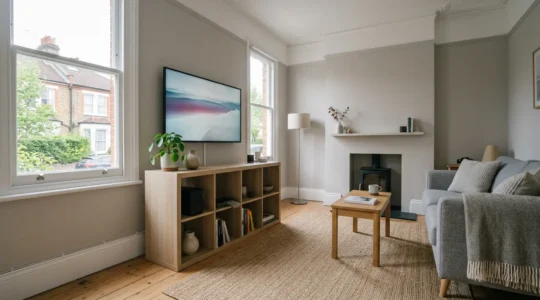
How to Architect a Media Server That the Whole UK Household Will Actually Use
The success of a home media server isn’t measured in terabytes or CPU cores, but by its ‘Partner Acceptance Factor’ (PAF)—its ability to work flawlessly for the least technical person in your UK household. Prioritise user experience (Plex/Jellyfin) and quiet,…
Lire la suite
How to install in-ceiling speakers during a UK loft conversion without structural issues?
Successfully integrating in-ceiling speakers into a UK loft conversion depends on treating them as a structural component from day one, not a decorative afterthought. Poor audio performance and noise transfer are almost always caused by improper installation within the ceiling…
Lire la suite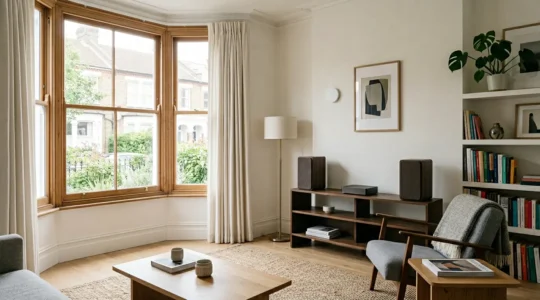
How to Stream Lossless Audio Without Buffering on UK Home Broadband?
The constant stutter of your lossless audio stream isn’t a failure of your broadband speed, but a failure of network stability within your home. Hi-res audio requires a consistent, low-jitter data flow, which is often disrupted by other devices on…
Lire la suite
How to Stream the Same Music to Every Room Without Noticeable Delay?
In summary: Your biggest enemy isn’t your speakers, but network congestion from your neighbours, especially during evening peaks. Solving boomy bass from a subwoofer requires a specific placement technique called the « Subwoofer Crawl, » not just pushing it into a corner….
Lire la suite
How to Stop Your Motion Sensor from Triggering Every Time the Cat Walks Past
In summary: Your sensor isn’t faulty; it’s being triggered by sudden changes in infrared energy from your pet. The solution isn’t just lowering sensitivity, but creating « intelligent blind spots » using physical masking and precise placement. Understanding the physics of how…
Lire la suite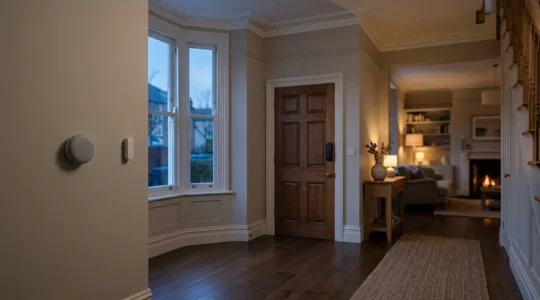
How to Secure Your Smart Home App: A UK Household’s Guide to Beating Hackers
Thinking a strong password is enough to protect your smart home? Think again. The real threats to UK smart homes are systemic issues like SIM-swapping, credential stuffing, and poorly managed family access—not just weak passwords. True security comes from auditing…
Lire la suite
How to Install a Video Doorbell That Complies With UK GDPR and Neighbour Privacy?
Installing a video doorbell in the UK requires more than just physical setup; it demands building a legally defensible security system to avoid significant legal and financial penalties. Your legal obligations under UK GDPR begin the moment your camera can…
Lire la suite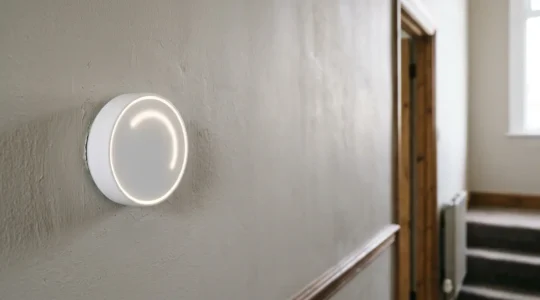
How to Train a Learning Thermostat to Cut Your UK Gas Bill by 20%?
In summary: Your smart thermostat isn’t saving you money because it’s fighting with other parts of your heating system, like radiator valves (TRVs). True savings come from « teaching » your thermostat about your home’s unique heat loss (its thermal inertia) and…
Lire la suite
How to Design a Home Lighting Scheme That Supports Your Body Clock Year-Round?
In summary: Your home’s lighting is a primary cause of body clock disruption, especially for those with irregular schedules. A strategic « light prescription »—managing spectrum, intensity, and timing—can actively realign your circadian rhythm. This involves using energising blue-rich light in the…
Lire la suite
How to Set Up Dimmers That Automatically Match Your Morning and Evening Routines
The key to better sleep and daytime energy isn’t manual scheduling, but creating an autonomous lighting system that works with your body’s natural clock. Cool, bright light in the morning boosts alertness, while warm, dim light in the evening is…
Lire la suite