The key to better sleep and daytime energy isn’t manual scheduling, but creating an autonomous lighting system that works with your body’s natural clock.
- Cool, bright light in the morning boosts alertness, while warm, dim light in the evening is scientifically proven to protect melatonin production.
- Advanced automation goes beyond timers, using contextual triggers like your work schedule or TV activity to adapt lighting scenes effortlessly.
Recommendation: Prioritise installing trailing-edge smart dimmers over just smart bulbs in key areas to ensure system reliability and avoid common issues like LED buzzing, especially in older UK properties.
For the modern UK professional, the line between a productive day and a restorative evening is often blurred by artificial light. You finish a late-night work session under a bright kitchen light, then struggle to wind down. Or you wake up on a dark winter morning feeling groggy and unmotivated. The common advice is to use smart bulbs and set a simple schedule, but this approach often fails because it’s rigid and requires constant manual override. It treats light as a simple utility, not as the powerful environmental signal it is.
The conversation around smart lighting is often limited to convenience and colour-changing novelties. But what if the true value lies in supporting your health? The science of our internal body clock, or circadian rhythm, shows that the colour and intensity of light have a profound biological impact. The problem is that standard lighting ignores this, bathing us in biologically-inappropriate « blue light » in the evenings and failing to provide the energising light we need during the day. This isn’t just about aesthetics; it’s about a fundamental mismatch between our environment and our biology.
This guide offers a different perspective. The goal is not just to program your lights, but to achieve a state of autonomous adaptation, where your home’s lighting intelligently supports your circadian health without you having to think about it. We will move beyond the platitudes of « warm light at night » and delve into the science of melatonin, the technology of contextual triggers, and the practical engineering required to solve real-world challenges in UK homes, from Victorian wiring to the infamous buzzing of dimmed LEDs. We’ll build a framework for a home lighting scheme that truly works for you, year-round.
This article provides a comprehensive roadmap, exploring the scientific principles, the technological choices, and the practical implementation steps. The following sections break down how to design and build a lighting system that enhances your well-being, from understanding the biology to mastering the hardware.
Summary: Designing a Home Lighting Scheme That Supports Your Body Clock
- Why Does Warm Light at 9 PM Help You Sleep Better Than Cool White?
- How to Create One-Touch Lighting Scenes for Work, Dinner and Movie Night?
- Dimmer Switch or Smart Bulb: Which Gives Better Control in a UK Victorian House?
- The LED Buzz Mistake That Ruins Ambiance in 30% of Dimmed UK Rooms
- When Should You Install Smart Dimmers to Maximise Time-of-Use Energy Savings?
- When Is the Best Time of Day to Spend 15 Minutes in Your Garden for Stress Relief?
- Why Does Your Bright Bathroom Light Sabotage Your Sleep Routine?
- How to Design a Home Lighting Scheme That Supports Your Body Clock Year-Round?
Why Does Warm Light at 9 PM Help You Sleep Better Than Cool White?
The advice to use « warm light » in the evening is common, but understanding the underlying science is key to effective implementation. The reason comes down to a hormone called melatonin, your body’s « signal for darkness. » Its production is highly sensitive to the spectrum of light you’re exposed to, particularly the blue wavelengths (around 480nm) that are abundant in daylight and cool-white artificial light (4000K and above). When your eyes detect this light at night, your brain’s master clock interprets it as daytime and suppresses melatonin production, delaying the onset of sleep and reducing its quality.
The difference between warm and cool light is not trivial. In fact, recent research published in Scientific Reports demonstrates that cool white LED light can cause over three times more melatonin suppression than warm white light. This is because warm light (typically 2200K-3000K) has a significantly lower concentration of these disruptive blue wavelengths. One landmark study on habitual light exposure found that regular room light before bed suppressed the onset of melatonin in 99% of individuals and effectively shortened the body’s perceived night by about 90 minutes. This creates a state of « social jetlag, » where your internal clock is out of sync with your actual sleep schedule.

Therefore, good lighting hygiene isn’t just about dimming the lights; it’s about actively managing the colour spectrum. Switching to a warm, amber-toned light source of around 2200K to 2700K at least two hours before bed sends a clear, congruent signal to your brain that the day is ending. This allows melatonin to rise naturally, preparing your body for a restful and restorative night’s sleep. It’s the single most impactful change you can make to your evening environment.
How to Create One-Touch Lighting Scenes for Work, Dinner and Movie Night?
A truly smart lighting system moves beyond simple on/off timers to embrace autonomous adaptation. The goal is for your lighting to adjust automatically based on your activities, creating the right ambiance and biological cues without you touching a switch. This is achieved by creating « scenes » — pre-set combinations of brightness and colour temperature — and linking them to contextual triggers. A scene for ‘Work Mode’ might be 100% brightness at a cool 5000K for maximum focus, while ‘Movie Night’ could be 10% brightness at a very warm 2200K to protect melatonin.
The brain of this operation is a smart home hub. While basic apps like Philips Hue are great for manual scene selection, a more powerful platform like Home Assistant, SmartThings, or Hubitat is needed for true automation. These hubs can integrate with a vast range of devices and services, allowing you to create sophisticated « if-this-then-that » rules. For example, you can link your ‘Work Mode’ scene to your work calendar or the network status of your computer, so the lights adjust automatically when you start your workday. ‘Movie Night’ can be triggered when your Apple TV or Chromecast becomes active.
This table compares popular platforms that can facilitate this level of automation, highlighting the trade-offs between power and ease of use for a UK-based user.
| Platform | Device Triggers | Calendar Integration | Manual Override | Learning Curve | Cost |
|---|---|---|---|---|---|
| Home Assistant | Extensive (computer status, network devices, media players) | Yes (Google, iCal, Outlook) | Virtual switches, guest mode | Steep (requires YAML or visual editor) | Free (open source) |
| IFTTT | Moderate (limited to supported applets) | Yes (Google Calendar) | Manual applet disable | Beginner-friendly | Free tier limited; Pro $2.50/month |
| SmartThings | Good (Samsung ecosystem devices) | Limited (via third-party apps) | Automation pause feature | Moderate | Free with compatible hub |
| Philips Hue App | Basic (motion, time-based) | No native support | Scene manual activation | Very easy | Free (requires Hue bridge) |
A crucial element of a usable system is a manual override. A « Guest Mode » virtual switch is essential for social events, temporarily disabling time-based dimming so your lights don’t unceremoniously fade to black while you have company. By combining well-defined scenes with these contextual triggers, your lighting shifts from a static utility to a dynamic, responsive part of your home environment.
Dimmer Switch or Smart Bulb: Which Gives Better Control in a UK Victorian House?
For owners of period properties in the UK, particularly Victorian homes, implementing smart lighting presents a unique challenge: outdated wiring. The core debate often comes down to using smart bulbs versus installing smart dimmer switches. While smart bulbs offer an easy entry point, they have a critical flaw: they require the wall switch to be permanently left ‘on’. If someone instinctively flicks the switch off, the bulb loses power and all smart functionality is lost. This is a common point of failure in many smart homes.
Smart dimmer switches, on the other hand, replace your existing wall switch, ensuring the circuit always has power for smart control while still offering familiar, physical interaction. The primary hurdle in older UK homes is the frequent absence of a neutral wire in the switch box, which most standard smart dimmers require to function. This has historically made installation difficult or impossible without costly rewiring. This is where a hybrid strategy, tailored to the home’s architecture, becomes essential.
Case Study: Solving the No-Neutral Problem in UK Period Homes
Recognising this widespread issue, UK-based manufacturer Repenic developed dimmer switches specifically for older properties. Their RD-250 and RD-400 Zigbee models are engineered to operate without a neutral wire, making them a direct-fit solution for Victorian-era wiring. These switches fit into standard 25mm UK back boxes and feature grounded metal faceplates that comply with UK electrical regulations. By using trailing-edge dimming technology, they also solve the flickering and buzzing commonly seen when pairing modern LEDs with older dimmers, preserving both the electrical integrity and the aesthetic of a period home.
The optimal solution is rarely one or the other, but a thoughtful combination. Use smart bulbs for irreplaceable period fixtures like ornate chandeliers or sconces where changing the switch is undesirable. This preserves the original aesthetic while adding smart control. For all other areas with standard ceiling roses or downlights, install no-neutral smart dimmer switches. This provides robust, reliable control that can’t be accidentally disabled and ensures a seamless experience for everyone in the household, blending modern automation with timeless architecture.
The LED Buzz Mistake That Ruins Ambiance in 30% of Dimmed UK Rooms
You’ve invested in beautiful light fittings and expensive dimmable LED bulbs, only to be met with an infuriating, ambiance-killing buzz or flicker the moment you dim them. This is an incredibly common problem in UK homes, and it’s almost always caused by a technological mismatch between the bulb and the dimmer switch. The mistake is assuming any dimmer works with any « dimmable » LED. The reality is far more complex.
The issue lies in two different types of dimming technology: leading-edge and trailing-edge. Leading-edge dimmers, the older and cheaper standard, were designed for high-wattage incandescent bulbs. They work by cutting off the front of the AC power wave. This abrupt action is too harsh for the sensitive electronics inside an LED bulb, causing the components to vibrate, which creates the audible buzz and visible flicker. Trailing-edge dimmers, a more modern technology, work by smoothly cutting off the back of the power wave. This gentler approach is specifically suited to the low power draw and delicate circuitry of LEDs, resulting in smooth, silent, and flicker-free dimming.
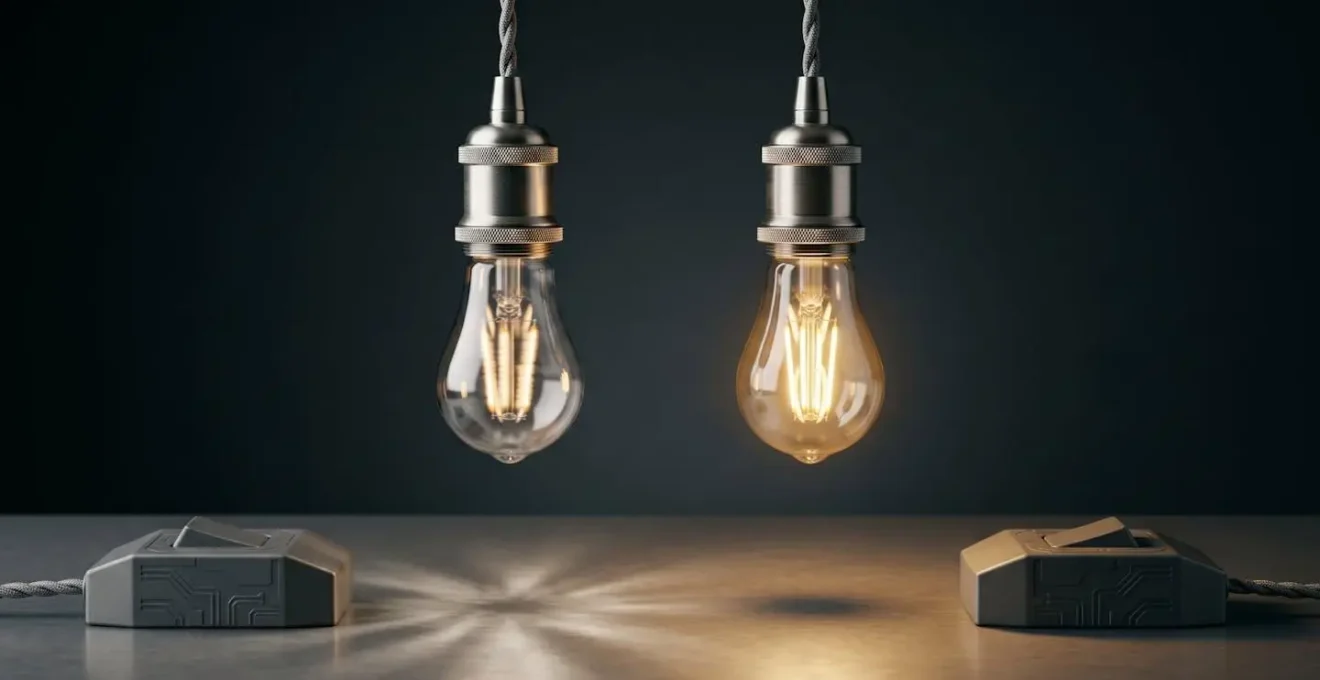
Upgrading to a high-quality trailing-edge dimmer is the definitive solution. The difference is night and day. In fact, according to Repenic’s engineering analysis of UK home renovations, installing a trailing-edge dimmer specifically designed for LEDs can eliminate buzzing and flickering in 99% of retrofit cases. Some advanced models even include a « BOOST » mode to handle very low-wattage circuits, ensuring compatibility across a wide range of LED bulbs. Investing in the correct dimmer technology is not an optional extra; it is fundamental to achieving the sophisticated, silent ambiance that is the entire point of a dimmable lighting system.
When Should You Install Smart Dimmers to Maximise Time-of-Use Energy Savings?
While the primary driver for circadian lighting is health and well-being, a significant secondary benefit is energy efficiency. Smart dimming and automation can lead to substantial cost savings, particularly when strategically deployed. The instinct might be to dim lights only in the evening, but the biggest savings come from systems that intelligently reduce artificial light usage during the day. This is achieved through a technology called daylight harvesting.
Daylight harvesting uses ambient light sensors to measure the amount of natural light entering a room. The smart system then automatically dims the artificial lights to the minimum level needed to maintain a consistent, pre-set brightness. On a bright, sunny day, your lights might dim to just 10-20% of their maximum output, or turn off entirely, without you noticing a change. The energy savings from this single strategy are profound. A 2025 study published in Scientific Reports demonstrated that automatic dimming systems equipped with ambient light sensors achieved a staggering 75.65% reduction in electricity consumption compared to manual controls.
These savings are further amplified when combined with presence detection (occupancy sensors) and time-of-use energy tariffs, which are becoming more common in the UK. By automating lights to dim or turn off in unoccupied rooms and programming the system to minimise usage during peak-rate electricity periods, the financial benefits accumulate quickly. A large-scale commercial retrofit at Ascension Health’s fitness facility provides a compelling example. By implementing wireless LED controls with occupancy and daylight sensors, they achieved annual energy savings of 1.3 million kWh, translating to over $130,000 in cost savings per year. While a home system is smaller, the principles are identical: you save the most by automating the reduction of light you don’t need.
When Is the Best Time of Day to Spend 15 Minutes in Your Garden for Stress Relief?
Effective lighting hygiene isn’t just about managing your indoor environment; it’s also about ensuring you get enough natural light, especially in the morning. A 15-minute break in your garden or even just a brisk walk can have a powerful, anchoring effect on your body clock, and the best time to do it is within the first hour or two of waking. This is because morning sunlight is rich in the very same blue wavelengths that we try to avoid at night. During the day, this light is beneficial, sending a strong « wake up » signal to your brain, boosting alertness, improving mood, and locking in your circadian rhythm for the entire day.
The intensity of outdoor light, even on a cloudy UK morning, is dramatically different from indoor lighting. The research on circadian health reveals orders of magnitude difference in light intensity (measured in lux) between a typical indoor space (100-300 lux) and the outdoors (1,000 lux on a very overcast day, to over 100,000 lux in direct sun). This powerful dose of morning light is something that artificial lighting struggles to replicate. It sets a high-amplitude « day » signal that makes the « night » signal from your dim, warm evening lights even more effective.
This concept of contrast is the cornerstone of a healthy circadian cycle. As neuroscientist Laura Fonken of the University of Texas at Austin notes when commenting on light exposure research:
It’s not just about having too little light during the day or too much light at night. The study is highlighting that you really need this contrast.
– Laura Fonken, Neuroscientist at the University of Texas at Austin, commenting on circadian light exposure research
By consciously seeking out bright, natural light in the morning, you create a robust daily rhythm. This small habit of spending just 15 minutes outdoors after waking enhances the effectiveness of your entire indoor smart lighting system, making your body more sensitive to the gentle, sleep-promoting cues you provide it in the evening.
Why Does Your Bright Bathroom Light Sabotage Your Sleep Routine?
You’ve curated the perfect, dim, warm lighting in your living room and bedroom, practicing excellent sleep hygiene all evening. Then, just before bed or during a middle-of-the-night trip to the loo, you flick on the bathroom light. The sudden blast of bright, cool-white light from the overhead fixture or mirror vanity is one of the most common and potent saboteurs of a healthy sleep routine. This single action can send a powerful « daytime » signal to your brain, instantly halting melatonin production and making it much harder to fall back asleep.
The solution is not to stumble around in the dark. Instead, it’s to apply the same circadian principles to the bathroom with a dedicated, automated « night mode. » The most effective night lighting uses not just dim white light, but pure red light. This is because photoreceptors in the eye that regulate melatonin are least sensitive to the red end of the spectrum. A 2024 comparative LED study published in PMC found that after two hours of evening exposure, melatonin levels were over three times higher under red light compared to blue light. For a brief night-time visit, this means red light is significantly less disruptive to your sleep cycle than even the warmest white light.
Implementing this is a perfect task for smart automation, triggered by a motion sensor. By setting a few simple rules, you can create a system that is both safe and sleep-preserving.
Action Plan: Your Sleep-Preserving Bathroom Lighting Recipe
- Create a Time-Gated Rule: In your smart home hub, set an automation: ‘IF time is between 11 PM and 6 AM AND bathroom motion is detected, THEN activate light at 5% brightness and 2200K (or red colour)’.
- Use Multi-Tap Switches: For smart switches (like Inovelli or Zooz), program a double-tap to trigger this ultra-dim ‘night mode’, while a single tap retains normal daytime brightness.
- Prioritise Red Spectrum: If using RGB smart bulbs, create a dedicated ‘Night Bathroom’ scene using only red light. This offers the absolute minimum impact on melatonin.
- Add a Lux Sensor: Configure the motion sensor to only trigger the automation when the room is dark (below a certain lux level), preventing it from activating during the day.
- Set an Auto-Off Timer: Have the light automatically turn off after 5-10 minutes of no motion, ensuring it doesn’t stay on accidentally.
This small, targeted automation project has an outsized impact on maintaining sleep continuity, effectively closing one of the most common loopholes in an otherwise well-designed circadian lighting scheme.
Key Takeaways
- The goal of smart lighting should be autonomous adaptation to your body clock, not just manual scheduling.
- The technological choice between a smart dimmer and a smart bulb has significant implications for reliability, especially in older UK homes with no-neutral wiring.
- Effective circadian lighting relies on high contrast: bright, blue-rich light in the morning (ideally natural) and dim, warm-to-red light in the evening.
How to Design a Home Lighting Scheme That Supports Your Body Clock Year-Round?
Designing a lighting scheme that truly supports your body clock is about creating a holistic, adaptive ecosystem. It’s a shift in mindset from « decorating with light » to « practicing good lighting hygiene. » The principles we’ve discussed — managing colour temperature, automating scenes with contextual triggers, solving hardware challenges, and seeking natural light — all come together to form a cohesive strategy. The ultimate goal is to create a stable and regular daily light-dark cycle that reinforces the natural rhythm of your body.
The foundation of this strategy is contrast. Your home should be a bright, energising environment during the day, ideally supplemented by natural sunlight, and a calm, dark environment at night. In the evening, the aim is to reduce your exposure to what scientists call « melanopic light. » The current scientific recommendations for healthy evening indoor light exposure endorse a maximum of 10 melanopic equivalent daylight illuminance (EDI) at eye level for at least three hours before bed. In practical terms, this means using very dim, very warm light sources that are positioned low in the room, mimicking the setting sun and campfire light our biology evolved with.
This isn’t about living in darkness. It’s about using the right light at the right time. A well-designed system, using a combination of smart dimmers for reliability and smart bulbs for flexibility, can achieve this automatically. It will gently transition from cool, bright light in the morning to a warm, dim glow in the evening, with targeted solutions for problem areas like the bathroom. As an expert panel from the Second International Workshop on Circadian and Neurophysiological Photometry concluded, « A stable and regular daily light-dark cycle is also likely to reinforce good alignment of circadian rhythms, which may further benefit sleep, cognition and health. »
By investing in an autonomous lighting system, you are not just buying smart gadgets; you are making a long-term investment in your health, aligning your modern home with the timeless needs of your biology. The next logical step is to audit your own home’s lighting and identify the key areas for improvement.