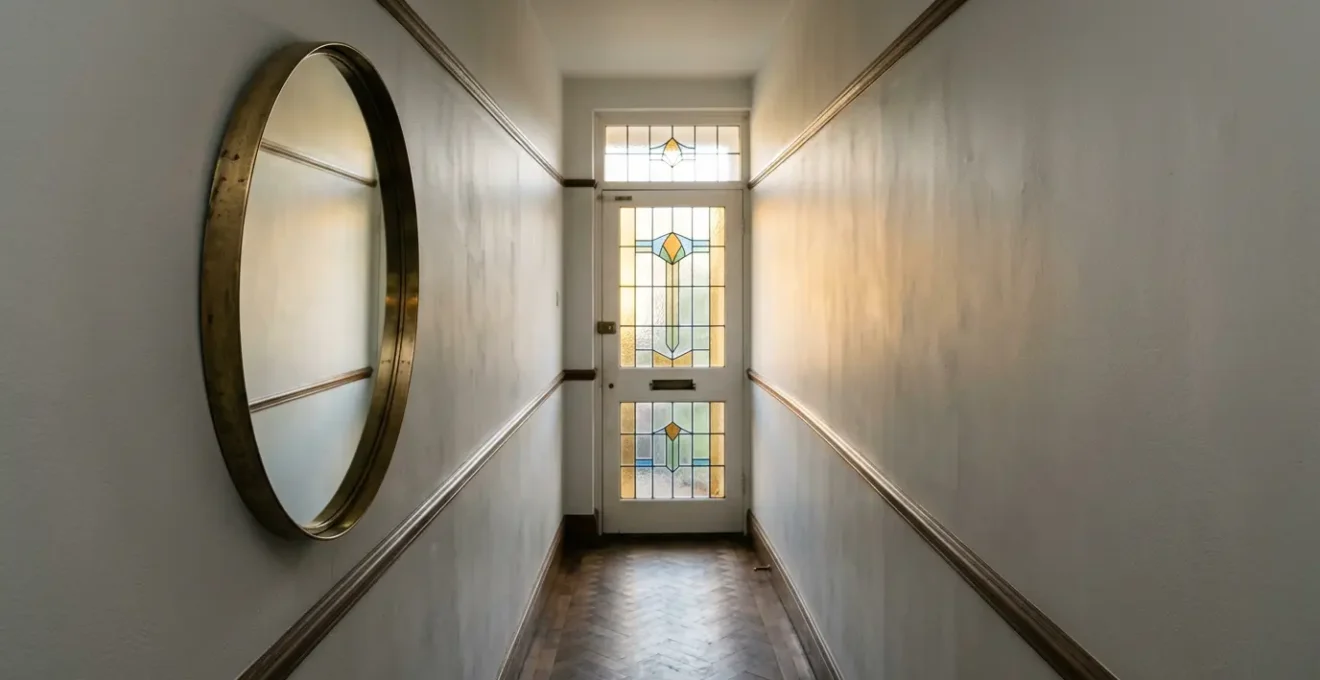
The secret to doubling light in a dark UK hallway isn’t placing a mirror opposite a window; it’s mastering the ‘secondary bounce’ to turn your walls into light sources.
- Angle the mirror to reflect borrowed light onto a plain, light-coloured wall, effectively ‘washing’ the space with soft, diffused illumination.
- Choose a mirror shape and frame that enhances, not constricts, your space by avoiding the psychological ‘aperture effect’ common with overly thick frames.
Recommendation: Before drilling any holes, use a small, handheld ‘scouting’ mirror to test potential positions and angles at different times of day to find the optimal placement.
For the owner of a north-facing Victorian terrace, the hallway often presents a specific and persistent challenge: a long, narrow, and chronically gloomy entrance. The conventional wisdom—to hang a large mirror to make the space feel bigger and brighter—is a common starting point. Many will simply place it opposite the front door, hoping to catch and reflect the daylight. Yet, this frequently results in a disappointing, glary patch of light that bounces straight back out the door, doing little to illuminate the corridor’s depths.
The problem is that we often treat mirrors as simple light reflectors rather than strategic tools of reflective geometry. The true art lies not in the direct reflection of a light source, but in the calculated redirection of that light. What if the most powerful technique was not to reflect the view from the window, but to use the mirror to paint a dark wall with borrowed light? This is the principle of the ‘secondary bounce’, a method that transforms a mirror from a simple decorative object into a high-performance lighting instrument.
This approach requires a deeper understanding of the material itself, from the living finish of unlacquered brass to the psychological impact of its frame. It’s about seeing the mirror as part of a system that includes wall colour, architectural features, and the unique quality of cool, northern light prevalent in the UK. This guide will deconstruct the process, moving beyond simplistic advice to provide a specialist’s framework for selecting, placing, and integrating a brass mirror to genuinely transform a dark hallway into a welcoming, luminous space.
To fully grasp how to turn your hallway from dim to dynamic, we will explore every facet of this design challenge. The following sections provide a detailed roadmap, from understanding the material’s properties to mastering the art of placement and creating a cohesive, warm aesthetic.
Summary: A Specialist’s Guide to Lighting a Hallway with a Brass Mirror
- Why Does Unlacquered Brass Develop Patina Faster in a Humid UK Bathroom?
- How to Choose Between Round, Arched and Rectangular Mirrors for a 1930s Semi?
- Solid Brass or Plated Steel: Which Frame Survives 10 Years Without Peeling?
- The Opposite-Wall Mistake That Makes Your Mirror Reflect Your Messiest Corner
- When Should You Buy Multiple Brass Pieces Together to Ensure Matching Patina?
- Why Does Your Hallway Feel Narrower After Adding a Statement Arch?
- Warm White or Cool White Walls: Which Creates Calm in a North-Facing UK Room?
- How to Create a Minimalist Living Room That Still Feels Warm and Inviting?
Why Does Unlacquered Brass Develop Patina Faster in a Humid UK Bathroom?
Understanding the behaviour of unlacquered brass begins with acknowledging its nature as a ‘living finish’. Unlike lacquered or plated metals, its surface is intentionally left unprotected to react with its environment. This reaction, or oxidation, creates the rich, warm patina that is so highly prized. In the United Kingdom, the generally damp climate provides the perfect conditions for this process. While a bathroom is an extreme example, the same principles apply to a cool, often-damp Victorian hallway.
The key catalyst is moisture. When water molecules in the air interact with the copper in the brass alloy, it accelerates the oxidation process. In fact, research on unlacquered brass ageing shows a patina development timeline that can be 30-50% faster in humid environments compared to dry ones. This means a mirror in a UK home will naturally develop character more quickly than one in a drier climate, transitioning from a bright, polished gold to deeper honey and caramel tones.
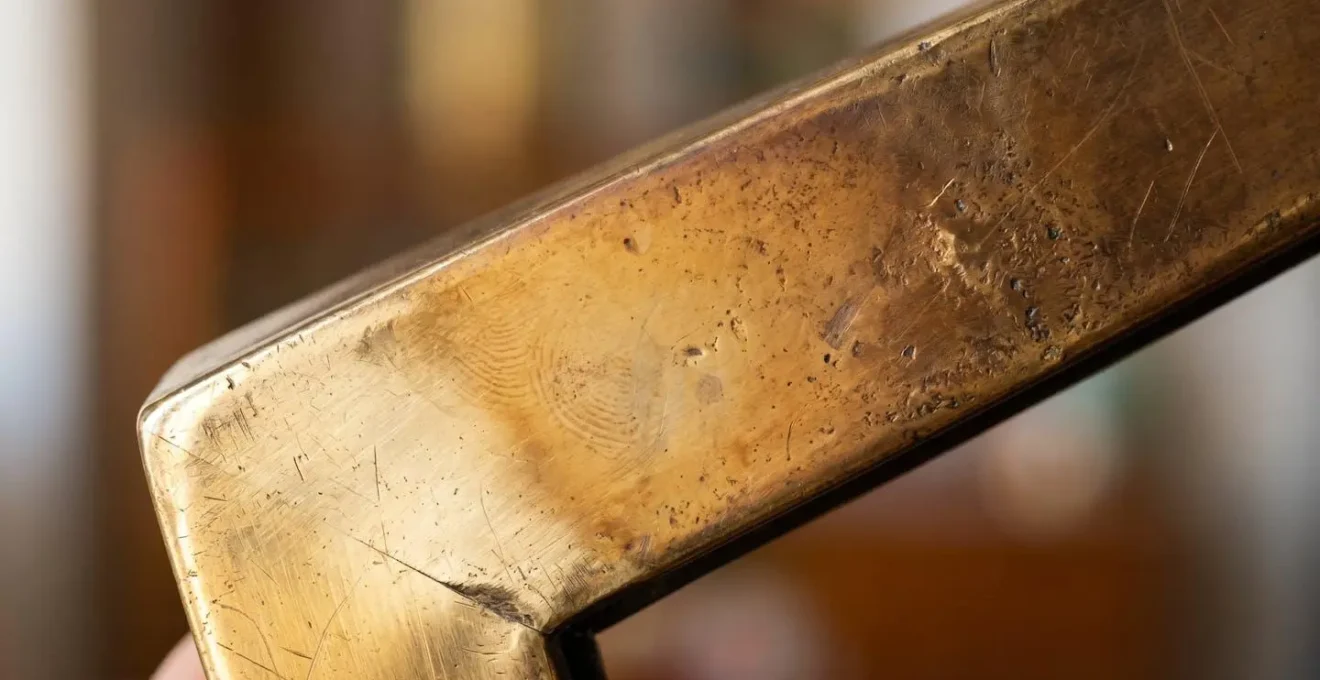
This transformation is not a defect; it is the primary aesthetic appeal of the material. Each fingerprint, every subtle shift in humidity, contributes to a unique pattern. For a dark hallway, this evolving warmth is a significant asset. A static, bright-yellow plated finish can feel cold and one-dimensional, but the deepening tones of a natural patina add visual warmth and a sense of history that counteracts the coolness of north-facing light. Embracing this process means selecting an object that brings not just light, but also life and character into the space.
How to Choose Between Round, Arched and Rectangular Mirrors for a 1930s Semi?
The shape of your mirror is not merely a stylistic choice; it’s a tool for architectural dialogue. In a home with distinct period features, like a 1930s semi-detached house, the mirror’s geometry can either complement or clash with the existing design language. The goal is to select a shape that respects the home’s character while achieving your primary goal of enhancing light and space. For a 1930s property, which often blends Art Deco linearity with softer curves, you have several excellent options.
A rectangular mirror, for instance, can be a powerful ally. When oriented horizontally, it creates a strong illusion of width, visually pushing the walls of a narrow hallway apart. If your home features the iconic Crittall-style windows or doors, a linear-framed rectangular mirror echoes this design feature, creating a sense of cohesion. Conversely, a round mirror introduces softness, providing a beautiful counterbalance to the angularity of 1930s architecture. It works particularly well to soften a space or to harmonise with a curved bay window, a common feature of the era.
The arched mirror is a particularly strategic choice. Its shape has a natural ‘lifting’ effect, drawing the eye upward and creating a sense of height—a valuable trick in hallways with standard or low ceilings. Finally, the sunburst mirror is a historically perfect hybrid, combining the softness of a round centre with linear rays that explicitly reference the goal of adding light. It is an authentic Art Deco detail that feels both period-appropriate and purposeful.
- Rectangular mirrors: Complement Crittall-style windows and doors. When oriented horizontally, they create a strong illusion of width in narrow halls.
- Round mirrors: Soften angular 1930s architecture and balance the curves of bay windows, providing contrast to geometric Art Deco patterns.
- Arched mirrors: Provide a ‘lifting’ effect to draw the eye upward. Best in frameless or thin-framed versions to avoid visual constriction.
- Sunburst mirrors: A historically appropriate hybrid for 1930s homes, combining the softness of a round shape with rays that explicitly reference light-adding goals.
Solid Brass or Plated Steel: Which Frame Survives 10 Years Without Peeling?
When selecting a brass mirror, one of the most critical decisions affecting its long-term performance and beauty is the choice between a solid brass frame and a brass-plated steel one. While they may look similar initially, their behaviour over a decade is vastly different, especially in a UK home. The lower initial cost of plated steel is tempting, but its long-term durability is significantly inferior. Plating is an incredibly thin coating, often less than 0.0005 inches thick, applied over a base metal like steel.
This thin layer is vulnerable. Any scratch or chip in the protective lacquer will expose the steel beneath. Once exposed to the ambient moisture of a typical UK home, that steel will begin to rust. This leads to the familiar, unsightly outcome: bubbling, peeling, and patchy tarnishing that cannot be repaired. In contrast, solid brass is a homogenous alloy. It contains no steel to rust and no plating to peel. As an expert from MAS Chrome Electroplating notes, this is the key to its longevity.
Solid brass has a higher upfront cost but can last decades or even centuries. With solid brass, worn or damaged areas can often be buffed or re-polished to restore the original finish.
– MAS Chrome Electroplating, Does Brass Plating Last? Durability and Longevity Guide
The degradation pattern is the crucial differentiator. Plated steel fails permanently. Solid brass simply ages, developing a reversible patina. After ten years, a plated frame in a high-traffic hallway will likely show signs of coating failure. A solid brass frame, however, will have developed a graceful, warm patina that can either be cherished for its character or, if desired, be re-polished back to its original lustre. For a project focused on light quality, preserving the reflective surface is paramount. The irreversible degradation of a plated finish ultimately diminishes its ability to reflect light beautifully.
This detailed comparison highlights the fundamental differences in how these materials age and perform over the long term.
| Characteristic | Solid Brass | Brass-Plated Steel |
|---|---|---|
| Lifespan | Decades to centuries | Few years with regular use (thin plating under .0005″) |
| Degradation Pattern | Develops reversible patina; can be re-polished to original luster | Lacquer chips/scratches expose base metal; leads to rust and patchy tarnishing |
| Repairability | Worn areas can be buffed or re-polished | Requires complete re-plating; cannot be spot-repaired |
| 10-Year Outcome | Develops graceful patina or maintains polish with care; structurally sound | Likely shows peeling, rust exposure, and coating failure in high-use areas |
The Opposite-Wall Mistake That Makes Your Mirror Reflect Your Messiest Corner
The single most common error in mirror placement is positioning it flat against a wall directly opposite a light source, like a front door or window. The intuitive logic is to « catch the light, » but in a narrow Victorian hallway, this often achieves the opposite effect: it creates a blinding glare and bounces most of that precious light straight back out. The true specialist technique is the ‘secondary bounce’. This involves angling the mirror to catch the light and redirect it onto an adjacent, plain, light-coloured wall. This turns the wall itself into a large, diffuse secondary light source, ‘washing’ the space in soft, usable illumination rather than creating a harsh focal point.
This method also solves another critical problem: reflecting clutter. A mirror doubles whatever it sees. Placed without thought, it can amplify the visual noise of a coat rack, a pile of shoes, or an unattractive architectural feature. The ‘secondary bounce’ allows you to be highly selective about the reflection. By carefully angling the mirror, you can choose to reflect a calm, empty stretch of wall or a bright patch of ceiling, effectively editing out the mess and amplifying the sense of space and tranquillity.
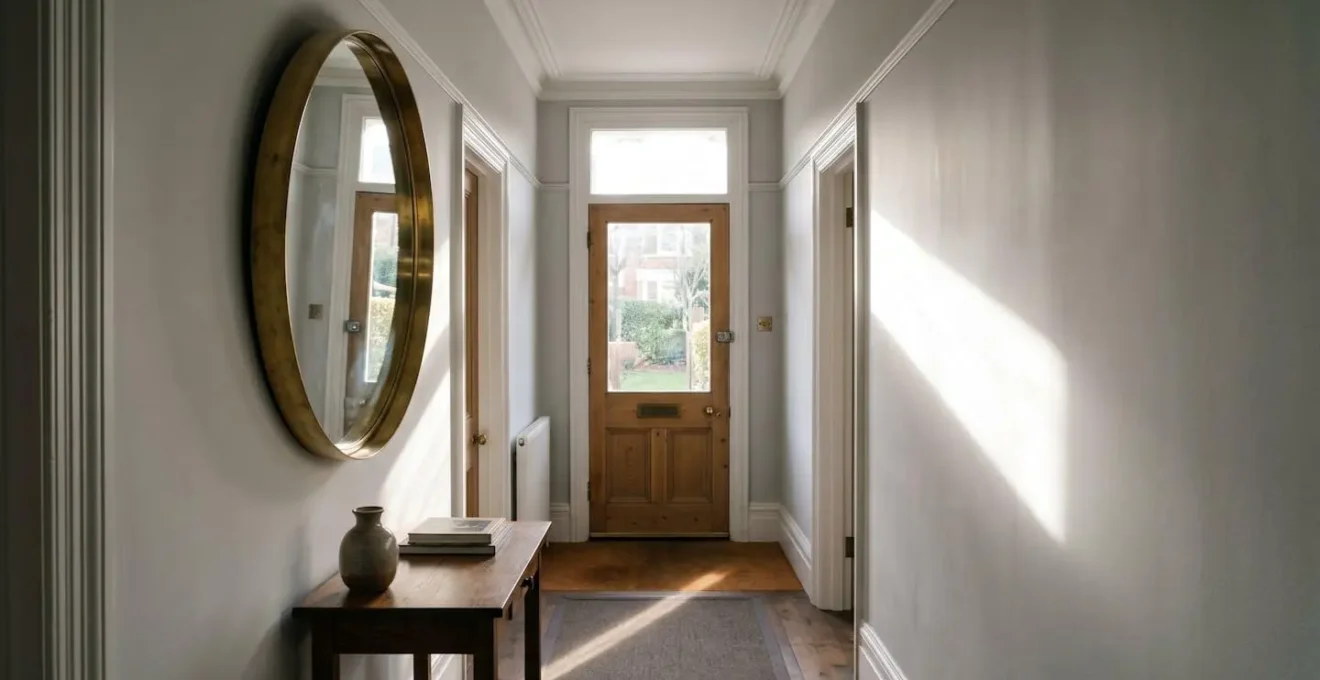
Mastering this requires a practical, hands-on approach before you commit to drilling. The ‘Scouting Method’ is a simple but invaluable technique for finding the perfect position and angle. It removes all guesswork and ensures your mirror works as hard as possible to brighten your space. By testing positions at different times of day, you can map the path of light and find the exact spot where your mirror will have the most significant impact.
Your Action Plan: The Scouting Method for Perfect Mirror Placement
- Gather tools: Use a small handheld mirror (around 12-18 inches) as your scouting tool. Visit your hallway at different times of day (morning, midday, late afternoon) to understand the light’s journey.
- Test positions: Hold the handheld mirror flat against the wall at each potential mounting spot. Observe precisely what it reflects at each location and time.
- Evaluate light sources: Position the mirror to catch light from your doorway or window and bounce it onto a plain, light-coloured wall. Actively avoid reflecting clutter, storage areas, or unattractive features.
- Test angles: Angle the small mirror slightly. Tilt it down to direct light onto the floor, or angle it slightly up to brighten the ceiling. Note how a mirror flat against a wall opposite a window often wastes light.
- Mark and confirm: Once you identify the optimal position and angle through scouting, mark the wall. Re-test at different times before you drill any permanent holes to be absolutely certain.
When Should You Buy Multiple Brass Pieces Together to Ensure Matching Patina?
As you integrate brass elements into your hallway, a common question arises: should everything match perfectly? The answer depends on a philosophy of ‘curated, not matched’. While a uniform look can be desirable in some contexts, the beauty of a living finish like unlacquered brass lies in its subtle variations. A home that feels collected over time is often more inviting than one that looks like a showroom. However, there are specific instances where ensuring a perfect match from the same production batch is crucial.
The key is the ‘Physical Proximity Test’. If two or more brass items will be seen as a single visual unit, they must match. A pair of wall sconces flanking your statement mirror, for example, will be perceived as a set. If their patinas develop at vastly different rates due to being from different batches, the effect will be jarring. In this case, it is essential to purchase them together, from the same supplier and ideally from the same production run, to guarantee they age in harmony.
Conversely, the ‘Visual Separation Test’ gives you freedom. If brass items are separated by a significant distance—for instance, the hallway mirror versus a door handle ten feet away—there is no need for them to match. The natural separation allows the eye to perceive them as distinct elements. This is where you can embrace a more organic approach, adding smaller brass accents like light switches or drawer pulls over time. Allowing each to develop its own unique patina based on its specific location and how often it is touched will create a richer, more authentic, and layered interior design.
- Identify your ‘Master’ piece: Select your large statement mirror first. This anchors your design and sets the baseline for the patina.
- Apply the ‘Physical Proximity Test’: If items create a single visual unit (e.g., a pair of sconces next to the mirror), buy them together from the same batch.
- Apply the ‘Visual Separation Test’: If items are separated by more than 3-4 feet, feel free to mix finishes and patina levels for a more natural, collected look.
- Embrace ‘Curated, Not Matched’: Intentionally select pieces with slightly different finishes to create a richer, more authentic interior.
Why Does Your Hallway Feel Narrower After Adding a Statement Arch?
An arched mirror should, in theory, add a sense of height and grace to a hallway. However, some homeowners are surprised to find that their new statement arch actually makes the space feel more constricted. This counter-intuitive outcome is a well-documented psychological phenomenon in interior design, often referred to as the ‘aperture effect’. The frame of the mirror plays a crucial role in triggering this perception.
When an arch mirror has a thick, dark, or visually heavy frame, our brains can subconsciously interpret it as a ‘keyhole’ or a narrow opening through which we are viewing the space beyond. As one study on the psychology of interior design explains, this creates a sense of compression. This is especially true in the tight confines of a typical British terraced house hallway, where every inch of perceived width counts.
A thick, dark-framed arch mirror can create a subconscious ‘keyhole’ or ‘aperture’ effect, making the brain perceive the space as being viewed through a narrow opening, thus feeling smaller.
– Interior Design Psychology Research, Mirror Placement Secrets for Small Spaces
To harness the height-adding benefit of an arch without accidentally narrowing the space, the solution lies in the frame’s design. A thin, delicate frame (1 inch or less) or a completely frameless arch provides the ‘lifting’ effect without the constricting visual weight. It creates the illusion of a window or an opening into another space, which expands the room’s perceived volume. If the primary problem is a lack of width, a wide, horizontally-oriented rectangular mirror is a more effective tool, as its strong horizontal lines visually push the walls apart. The choice between these shapes is a strategic decision about which spatial problem—height or width—is the priority.
The following table breaks down how different frame choices impact the feeling of space in a narrow hallway.
| Frame Type | Visual Effect | Best Use Case | Avoid When |
|---|---|---|---|
| Thick, Dark Frame (3+ inches) | Creates ‘aperture effect’; frames view like a keyhole; adds visual weight that constricts space | Large, wide hallways with high ceilings where a statement piece is desired | Narrow corridors under 3 feet wide; low-ceiling hallways |
| Thin, Delicate Frame (1 inch or less) | Provides height-adding benefit of arch without narrowing effect; creates window illusion | Tight 1930s hallways; spaces needing vertical lift without horizontal constriction | When a substantial visual anchor is needed |
| Frameless Arch | Maximum ‘lifting’ effect; minimal visual intrusion; cleanest illusion of extended space | Modern or minimalist narrow hallways; when seamless integration is priority | Traditional interiors requiring period detail |
Warm White or Cool White Walls: Which Creates Calm in a North-Facing UK Room?
Choosing a wall colour for a north-facing room is a classic UK design dilemma. The natural light is cool, indirect, and has a grey or blueish tint. The common instinct is to counteract this coolness with a warm, creamy, or yellow-toned white. However, this can sometimes backfire. In the weak northern light, a yellow-based white can look sickly or dull, and the warm reflection from a brass mirror can amplify this yellowness to an overwhelming degree.
The more sophisticated approach is often to work *with* the cool light rather than against it. This means choosing a complex white with subtle cool undertones of grey, green, or even pink. These colours have enough complexity to avoid feeling stark or clinical in the northern light. The magic happens when you introduce the brass mirror. The warm, golden reflection of the brass cuts through the coolness of the paint, creating a perfect, balanced neutral light. The brass ‘warms up’ the cool wall, while the cool wall prevents the brass from looking too yellow. This interaction creates a dynamic, calming, and highly sophisticated atmosphere.
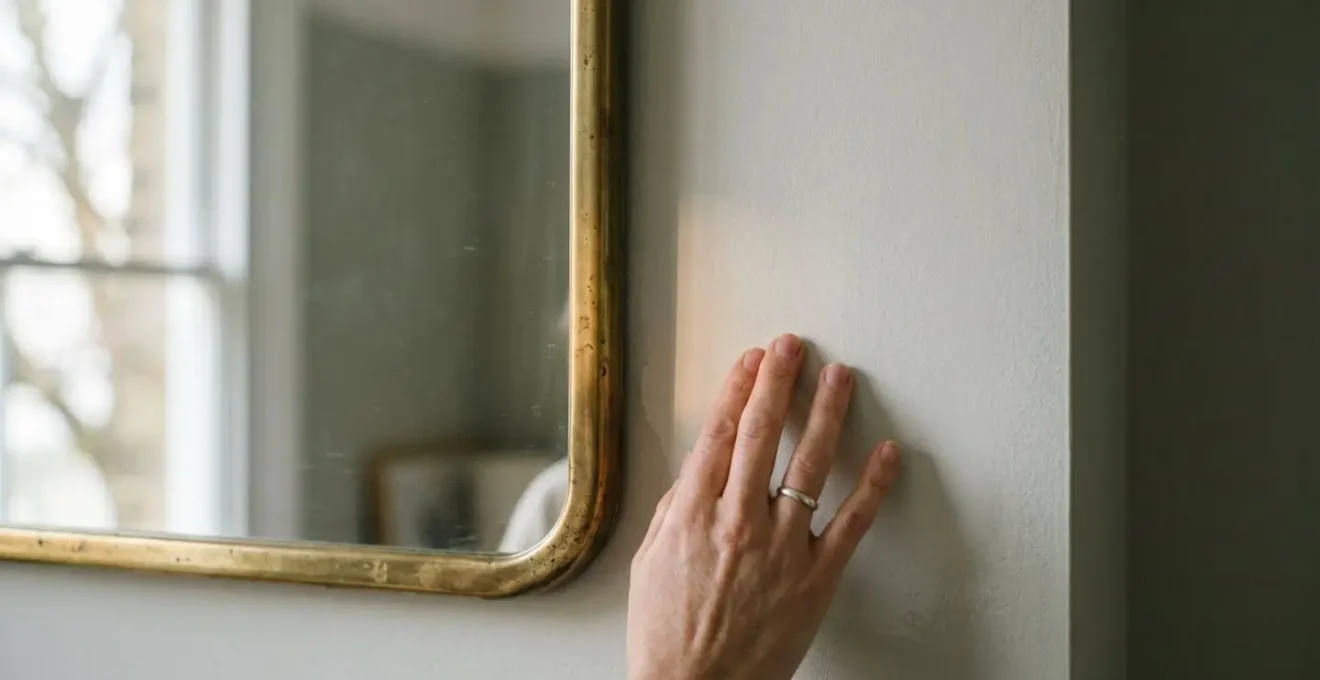
Because this effect is so dependent on the specific light in your home, you must never choose a paint colour from a tiny swatch in a shop. The ‘Live Sample Method’ is the only reliable way to make a decision. By painting large A2-sized cards and observing them next to your brass mirror at different times of the day, you can see exactly how the paint and the metal will interact in your unique lighting conditions. This process moves beyond the simple warm/cool binary and allows you to find the perfect, nuanced colour that will bring your hallway to life.
Follow these steps to test your paint choices effectively:
- Prepare large-scale samples: Paint A2-sized cards with your top 2-3 paint choices in the correct finish (e.g., matte). Let them dry for 24 hours.
- Position samples near brass: Tape the cards to the wall directly next to where your brass mirror will hang.
- Observe at multiple times: View the paint-brass interaction in the morning, at midday, and in the late afternoon to see how it changes with the cool UK light.
- Evaluate brass reflection impact: Note how the warm brass reflection interacts with each paint. Does it balance a cool white? Does it make a warm white too yellow? Does it enhance subtle undertones?
Key Takeaways
- Placement is Paramount: The ‘secondary bounce’ technique—angling a mirror to wash a plain wall with light—is more effective in a narrow hall than direct reflection of a window.
- Frame & Shape Matter: A thick frame can create a constricting ‘aperture effect’. Match the mirror’s shape (round, arch, rectangular) to your home’s architectural language to enhance, not fight, the space.
- Material is an Investment: Solid unlacquered brass develops a warm, living patina and is a long-term investment, while plated steel can peel and rust, diminishing light quality over time.
How to Create a Minimalist Living Room That Still Feels Warm and Inviting?
The principles used to illuminate a dark hallway can be expanded to define an entire design ethos: Warm Minimalism. This approach seeks to strip back the clutter and unnecessary ornamentation of traditional minimalism but avoids its potential for feeling cold or sterile. It achieves warmth not through adding more things, but by carefully selecting fewer, higher-quality items that have inherent texture, character, and a story to tell. An unlacquered brass mirror is the quintessential object for this philosophy.
In a minimalist space, every object must justify its existence, often by serving multiple functions. A large, high-quality brass mirror is the ultimate example of ‘functional art’. It is, at once, a practical tool for manipulating light and creating a sense of space, a place to check one’s appearance, and the sole, dramatic piece of wall art required for the room. This fulfils the ‘less is more’ principle in its purest form. Its reflective quality adds a layer of complexity and movement that static art cannot.
Case Study: The Brass Mirror as a ‘Warm Minimalism’ Statement
Contemporary minimalist interiors increasingly use unlacquered brass for its evolving quality and ability to add warmth without clutter. A single, large, high-quality brass mirror can serve as both a practical tool (light manipulation) and the sole piece of wall art, fulfilling the ‘less is more’ philosophy. The gradual patina development adds a depth and history that static finishes like chrome or glass cannot match. This bridges the gap between cold minimalism and warm minimalism, which celebrates tactile, natural materials that age gracefully, such as wood, wool, and unlacquered brass. This approach positions the mirror as ‘functional art’ where beauty and purpose coexist.
The ‘living finish’ is the key. While cool minimalism often relies on static, perfect surfaces like chrome and glass, warm minimalism embraces materials that evolve. The gradual, irreversible development of patina on an unlacquered brass frame introduces a layer of warmth, history, and personality. It prevents the space from feeling impersonal, telling a story of time and touch. Paired with other tactile materials like wood, wool, or linen, the brass mirror becomes the focal point of a room that is both serene and deeply inviting.
Begin by applying the ‘scouting method’ in your own hallway to identify the optimal position where a brass mirror can serve as your new, light-giving piece of functional art.