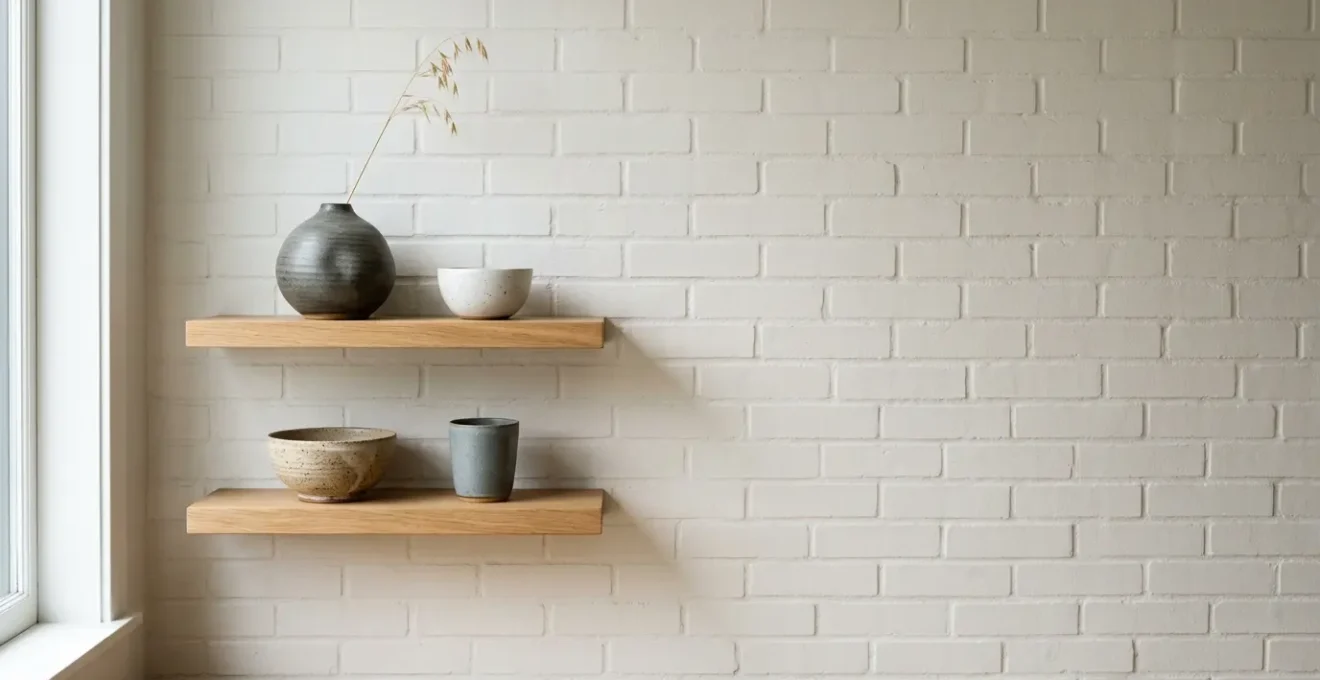
Transforming a pottery collection from clutter to a curated display isn’t about arrangement, but about understanding the interplay of light, form, and story.
- Matte glazes absorb light, creating calm, while shiny glazes reflect it, adding energy. Use this to set the mood of a display.
- Every piece has a dual identity—as a functional object and a piece of art. Honouring both is key to an authentic home.
Recommendation: Start by selecting one ‘hero’ piece from your collection and build a small, meaningful story around it, rather than trying to display everything at once.
Your shelves are brimming with beautiful, hand-thrown pottery. You’ve collected pieces from local fairs, travels, and favourite artists. Each one holds a story, a texture, a memory. Yet, when you step back, the overall effect is less ‘curated gallery’ and more ‘overwhelming gift shop’. The individual beauty of each piece is lost in a sea of visual noise, and the collection you love feels like a burden to manage. It’s a common frustration for enthusiasts whose passion outpaces their display strategy.
The standard advice—group by colour, use the rule of threes, vary heights—is often repeated but rarely solves the core problem. These are tactics for arranging objects, not for creating a home. They can lead to sterile, impersonal displays that still feel disconnected. The true challenge isn’t just about finding a spot for everything; it’s about making a collection feel like a cohesive, personal, and living part of your space.
But what if the secret isn’t about *arranging* objects, but about *orchestrating a conversation* between them? The key to unlocking your collection’s potential lies in a deeper understanding of its intrinsic qualities. This is not about following rigid design rules, but about learning to see your pottery through the eyes of a curator—considering how light interacts with glaze, how form dictates function, and how a piece’s origin story can connect with your own.
This guide will move beyond the superficial tips to explore the fundamental principles of styling artisan ceramics. We will delve into the physics of glaze, the investment value of different pottery traditions, and the psychological power of negative space. By the end, you will have a new framework for thinking about your collection, empowering you to create displays that are not just beautiful, but deeply meaningful.
To help you navigate this curated approach, we’ve structured this guide to address the most common and complex questions collectors face. Explore the topics below to build your confidence and refine your eye.
Summary: A Curated Approach to Styling Hand-Thrown Pottery
- Why Does Your Shiny Glaze Collection Clash While Matte Pieces Harmonise?
- How to Choose Pottery That Works Both as Art and for Everyday Use?
- British Studio Pottery or Japanese Import: Which Holds Value Over 20 Years?
- The Shelf-Packing Mistake That Obscures Your Best Ceramic Pieces
- When Do UK Ceramic Fairs Offer Direct Access to Award-Winning Potters?
- How to Connect a Vintage Vase, Modern Print and Travel Souvenir in One Display?
- Why Do Hand-Sewn Seams Look Uneven but Last Twice as Long?
- How to Verify Genuine Hand-Stitched Leather on a UK High-Street Armchair?
Why Does Your Shiny Glaze Collection Clash While Matte Pieces Harmonise?
The reason your collection of shiny, high-gloss pottery can feel visually chaotic while matte pieces seem to coexist peacefully lies in a simple principle of physics: light management. A high-gloss glaze acts like a mirror, reflecting light sources in sharp, defined points. When you group many shiny objects together, you create a multitude of competing highlights that fragment the view and create visual static. Each piece screams for attention, resulting in a display that feels busy and restless. Your eye doesn’t know where to land.
Matte glazes, on the other hand, perform a different kind of light choreography. They have a micro-textured surface that scatters light in countless directions. Instead of creating sharp reflections, they offer a soft, diffuse glow that feels calm and quiet. This quality allows the form and colour of the pot to take centre stage, rather than the reflection on its surface. As the Ceramics Arts Network explains, this effect is fundamental to their nature:
Matte glazes scatter reflected light in many or all directions, creating a surface that diffusely reflects light rather than creating sharp mirror-like reflections.
– Ceramics Arts Network, What Makes a Matte Glaze Matte? A Helpful Explanation of the Chemistry Behind Matte Glazes
This doesn’t mean you should banish shiny glazes. The key is strategic placement. Use a high-gloss piece as a ‘hero’ to catch the light and create a focal point in a darker corner. Surround it with matte or semi-matte pieces that will absorb some of that energy and create a balanced composition. Think of it as a conversation: the shiny piece is the extrovert telling a lively story, while the matte pieces are the engaged listeners, providing a calm and supportive backdrop.
By understanding that you are not just arranging shapes but choreographing light, you move from simply placing pottery to actively styling it.
How to Choose Pottery That Works Both as Art and for Everyday Use?
The most soulful homes are those where beauty and utility are not separate categories. Choosing pottery that lives in this space between art and everyday object is the cornerstone of a collection that feels both personal and alive. The distinction is less about the object itself and more about our willingness to embrace its dual identity. A perfect piece should be beautiful enough to command attention on a shelf, but also robust and ergonomic enough to feel right in your hands, holding your morning coffee or a bundle of fresh herbs.
Look for clues in the form. Does the handle of a mug invite your fingers? Does the lip of a bowl feel smooth and well-finished? Is the base sturdy and balanced? These are not just functional details; they are signs of a potter who understands the intimacy of use. This philosophy finds its roots in the Japanese concept of Wabi Sabi, which celebrates the beauty found in imperfection and the grace of an object aging through use. A small chip on a beloved bowl isn’t a flaw; it’s a memory.
This approach transforms your daily routines into small moments of appreciation, connecting you to the maker and the material. An olive oil bottle by the stove or a salt pig on the counter ceases to be mere storage and becomes a point of tactile pleasure.
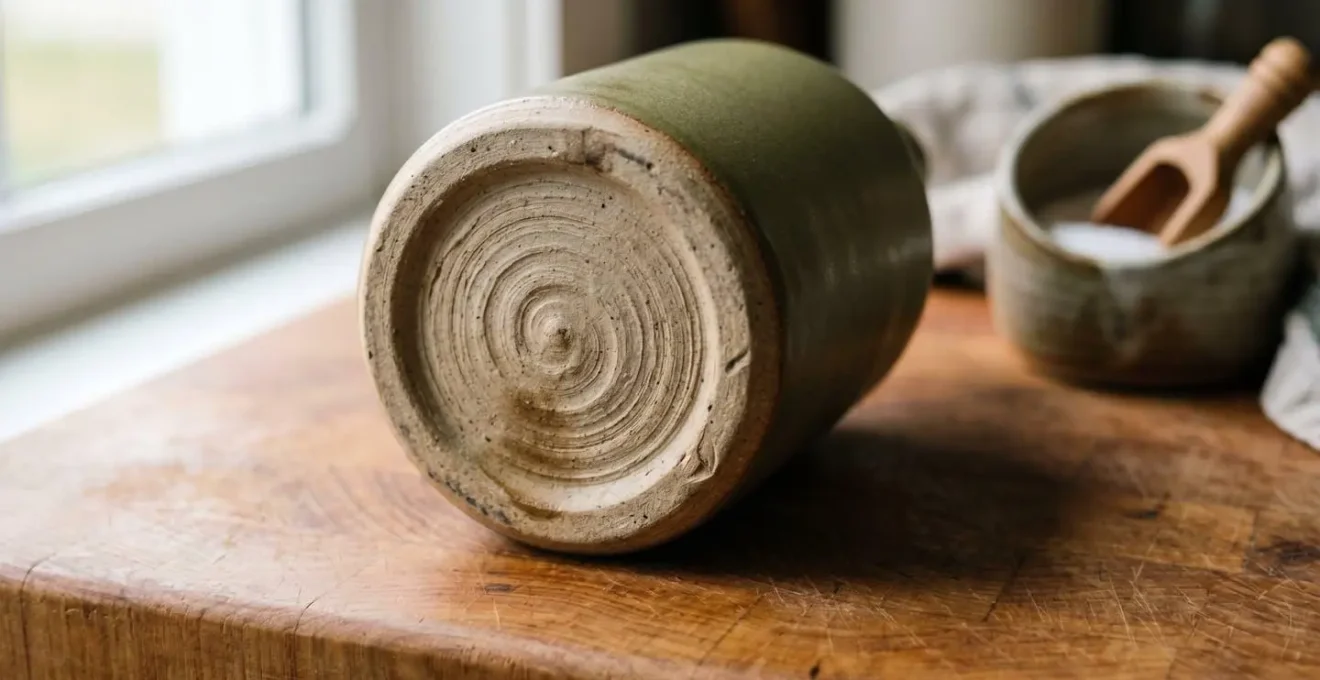
As the image illustrates, incorporating functional art into your most-used spaces ensures it’s appreciated daily. The true value of such pieces isn’t just in how they look, but in how they integrate into the narrative of your life. As one design expert notes, this embrace of the handmade is a core part of its appeal:
In ancient Japanese culture, the philosophy of Wabi Sabi celebrates the beauty of imperfection. When translated loosely, wabi means simplicity and sabi means the beauty of age and wear.
– Shabby Fufu, Handmade Home Decor and the Beauty of Imperfection
So, choose pieces that call to you not just visually, but physically. Don’t save your « good » pottery for special occasions. The most special occasion is now.
British Studio Pottery or Japanese Import: Which Holds Value Over 20 Years?
When collecting, the question of investment value inevitably arises. Both British Studio Pottery and traditional Japanese ceramics have robust secondary markets, but their value is driven by different, though often intersecting, principles of provenance, rarity, and influence. The truth is, the two traditions are deeply intertwined. The « Father of British Studio Pottery, » Bernard Leach, was profoundly influenced by his time in Japan, setting up his iconic St Ives pottery with Japanese potter Shoji Hamada. This fusion of Eastern philosophy and Western practice is the very DNA of the movement.
Historically, works by seminal figures of the British Studio movement, like Lucie Rie and Hans Coper, have proven to be formidable investments. Pieces by these artists command staggering prices at auction. For example, exceptional works by Lucie Rie can fetch between £130,000 and £140,000 at auction, demonstrating the long-term financial appreciation for master potters. This value is tied to their immense influence, limited output, and museum-quality significance.
The market’s momentum is undeniable. A 2021 auction of the Dr. John Driscoll collection at Phillips and Maak underscored this trend. The sale, which featured key British and international studio potters, shattered its pre-sale estimate, achieving a result 228% above the mid-estimate and setting 28 world auction records. This event highlights that the appetite for significant, story-rich ceramic art is stronger than ever, with collectors valuing the « maker’s hand » and historical importance.
For a 20-year outlook, the safest investment is always in pieces with a strong, verifiable story. This could be a piece by an established potter with a clear auction history (like those in the British Studio movement) or a Japanese piece from a renowned kiln or a lineage of potters. The key factor is provenance. Whether British or Japanese, a piece signed by a recognised artist, with a documented history, is far more likely to hold and increase its value than a beautiful but anonymous work.
Ultimately, the best strategy is to buy what you love but educate yourself on its context. A piece that brings you daily joy is an excellent return, and if it happens to be by a potter of historical note, its financial appreciation will be a welcome bonus.
The Shelf-Packing Mistake That Obscures Your Best Ceramic Pieces
The most common mistake a passionate collector makes is born from love: wanting to display everything at once. This leads to the « shelf-packing » phenomenon, where shelves are lined edge-to-edge with pottery. While the intention is to honour each piece, the result is the opposite. The individual forms merge into a single, cluttered mass, and the unique silhouette of each pot is lost. The eye sees a crowd, not a collection of individuals. The solution is counter-intuitive but powerful: display less to see more.
This is where the concept of active negative space comes in. Negative space is the empty area around and between your objects. It is not wasted space; it is a crucial design element that gives your pottery « room to breathe. » It frames the object, defines its shape, and directs the viewer’s eye. A single, beautiful vase placed on a shelf with generous space on either side has more visual impact and perceived value than a dozen similar vases crammed together.
To implement this, you must be ruthless. Select a « hero » piece for each display area—the one you love most or that has the most interesting form. Then, build a small vignette around it using a few complementary, not competing, pieces. Follow the classic styling rules, but with intention:
- Group in odd numbers: A group of three or five feels more dynamic and natural than an even-numbered group.
- Vary heights: Create a visual rhythm by mixing tall, medium, and small pieces, guiding the eye through the display.
- Layer in three dimensions: Don’t just line things up. Place taller items towards the back and smaller ones in front to create depth.
The goal is to move from a lineup to a composition. Think of your shelf as a canvas, and your pots as the subjects of a painting. The empty space is just as important as the brushstrokes.
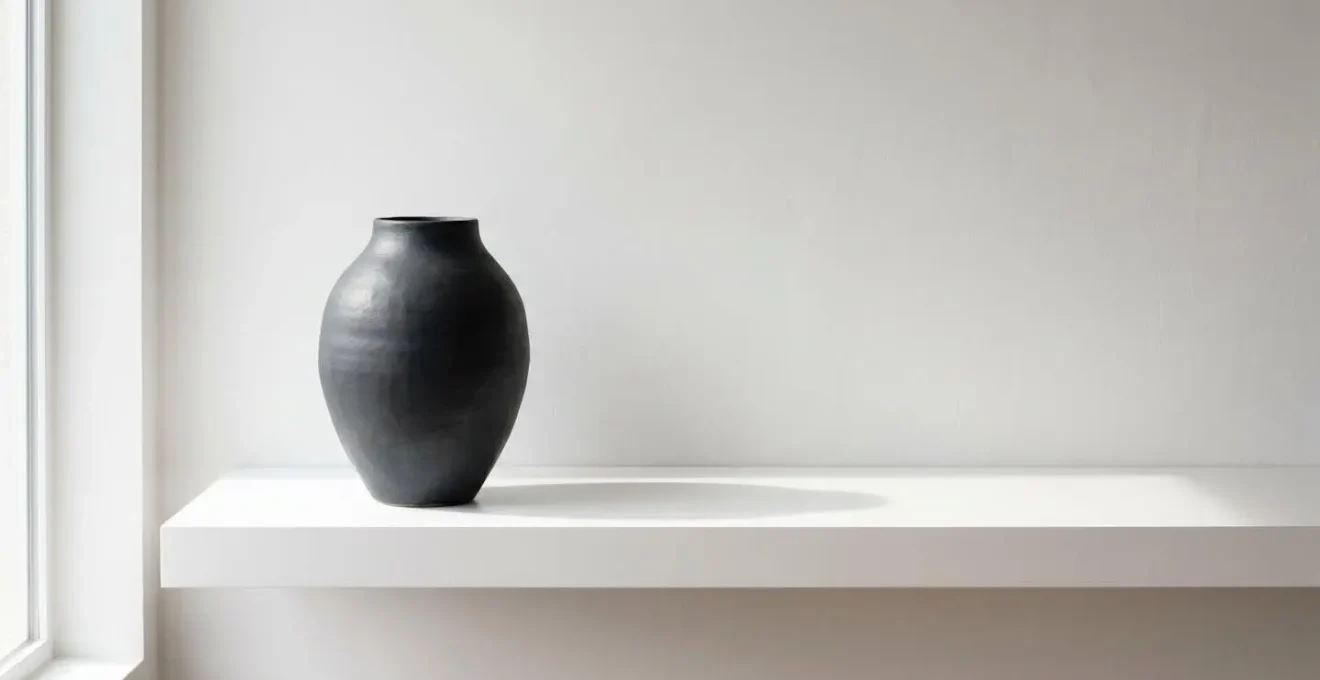
This image perfectly captures the power of restraint. The void is not empty; it’s full of potential, allowing the vase’s form to be the undisputed star. By embracing this « less is more » philosophy, you elevate your collection from a simple inventory to a curated exhibition.
Rotate your collection seasonally or whenever the mood strikes. This keeps your displays fresh and allows you to appreciate every single piece you own, one hero at a time.
When Do UK Ceramic Fairs Offer Direct Access to Award-Winning Potters?
For a ceramics enthusiast, nothing beats the experience of meeting the maker and buying a piece directly from their hands. UK ceramic fairs are the primary venues for this connection, offering unparalleled access to a wide spectrum of artists, from emerging talents to established, award-winning potters. The UK’s annual calendar is rich with high-quality events, each with its own distinct character, timed throughout the year.
The key to finding award-winning potters is to target the more prestigious, curated fairs. These events have a rigorous selection process, meaning every exhibitor has already met a high standard of quality and originality. The premier event in this category is arguably Ceramic Art London. Organised by the Craft Potters Association, it is a highly selective showcase where you can find work from internationally recognised artists alongside the next generation of stars. The 2025 edition, for instance, is set to feature 120 of the most significant makers, attracting serious collectors and gallery owners.
Beyond London, the Potfest series of events offers a more down-to-earth but equally high-calibre experience. Held in picturesque locations across the country, from Penrith to Scone Palace, Potfest prides itself on its « no art hype » atmosphere. Here, you’ll find a community of dedicated artists happy to discuss their process, making it an excellent opportunity to learn and connect. The annual calendar provides several key opportunities:
- Ceramic Art London (May, Olympia West): The UK’s most prestigious fair, ideal for finding investment-grade pieces and meeting established names.
- Potfest in the Park (Summer, Penrith): The flagship Potfest event, showcasing 100 artists in a relaxed, beautiful setting.
- Potfest Scotland (Summer, Scone Palace): A stunning location on palace lawns, bringing top studio ceramics to a Scottish audience.
- Potfest South East (May, Glynde Place): An accessible event for those in the south-east, set in the grounds of an Elizabethan country house.
- Ceramics in the City (September, Museum of the Home, London): A well-regarded show featuring a mix of functional tableware and unique collector pieces.
The best time to go is often during the opening night or a special preview event. While it might cost a little extra, it offers the first pick of the work and a more intimate setting to chat with the artists before the crowds arrive.
By attending these fairs, you are not just buying an object; you are investing in the artist and becoming part of the vibrant story of contemporary British ceramics.
How to Connect a Vintage Vase, Modern Print and Travel Souvenir in One Display?
The most compelling and personal displays—the ones that truly tell your story—are often composed of seemingly disparate objects. The challenge is to weave these individual items into a cohesive and pleasing whole. A vintage vase, a modern art print, and a small souvenir from a trip are not in conflict; they are three acts of your personal narrative. The key to connecting them is to create a « narrative vignette » by finding or creating a common thread.
This common thread can be one of three things: colour, texture, or form. Your first step is to identify a linking element. Perhaps the blue in the modern print picks up a subtle shade in the vintage vase’s glaze. Or maybe the rough texture of a travel souvenir echoes the unglazed base of a ceramic pot. Once you find this connection, you can build upon it. As one studio advises, layering is key:
Mixing pottery with books, framed art, or mirrors produces layered displays that feel personal and curated. Placing pottery in high-traffic areas ensures daily notice and appreciation.
– Ceramique Ceramic Studios, Display Your Painted Pottery with These Creative Tips
Books are a stylist’s secret weapon in this scenario. They act as visual bridges and versatile platforms. You can use the colour of a book’s spine to connect two objects or use a stack of books to elevate a smaller item to a more prominent height, creating a pleasing visual rhythm. Here are some practical strategies for creating unity:
- Create a Colour Story: Group the items together and add a fourth element—like a book or a small plant—that shares the dominant colour of the print or vase.
- Use Books as Risers: Place the vintage vase on a stack of old books to give it the height it needs to converse with the print hanging on the wall behind it.
- Layer with Purpose: Lean the modern print against the wall, place the taller vase slightly in front and to one side, and position the small travel souvenir in the foreground to create a sense of depth and discovery.
By thinking like a storyteller, you move beyond simple arrangement. You are not just placing objects; you are curating a memory, a feeling, a moment. The resulting vignette will be more powerful and personal than any perfectly matched set.
This approach allows your home to reflect the true, multi-layered nature of your life, not a catalogue-perfect version of it.
Key Takeaways
- Light Choreography: Matte glazes absorb light to create calm, while shiny glazes reflect it to add energy. Use this property to control the mood of your display.
- The Power of Provenance: A piece’s value, both monetary and sentimental, is deeply tied to its story—the who, where, and when of its creation.
- Active Negative Space: The empty space around an object is a powerful tool. Use it to frame your ‘hero’ pieces and give them room to breathe.
Why Do Hand-Sewn Seams Look Uneven but Last Twice as Long?
This question, though about textiles, holds the central truth for any collector of handmade goods, including pottery. The perceived « imperfection » of a hand-thrown pot—the slight asymmetry, the visible throwing rings inside, the unique drip of a glaze—is not a flaw. It is the autograph of the maker’s hand and the very source of the object’s strength, character, and soul. A machine can produce a thousand identical, perfect mugs. A potter can only make one-of-a-kind individuals.
This human touch is what separates craft from manufacturing. When you see the subtle variations in a set of « identical » handmade bowls, you are seeing the rhythm of the potter’s day, the slight differences in pressure and motion. These are not mistakes; they are evidence of a real person at a specific moment in time. For many collectors, this connection is the entire point. As one couple explained when designing their kitchen around their pottery collection, each piece is a vessel for memory, linking them to the people and places where they were acquired. The daily act of using these pots is an act of remembering.
This celebration of the maker’s mark is why a slightly irregular surface can be more desirable than a perfectly smooth one. It tells a story of process. A matte glaze, for example, is often chosen by potters specifically to enhance these subtle textures. As noted by ceramic experts, a matte surface can eliminate distracting reflections that might obscure the intricate details or drawings on a piece, allowing the form and the potter’s touch to be seen more clearly. The « uneven seam » is not a bug; it’s the feature.
In a world of mass production, choosing an object that bears the honest marks of its creation is a quiet rebellion. It is a declaration of value in humanity, imperfection, and things that are built to last.
How to Verify Genuine Hand-Stitched Leather on a UK High-Street Armchair?
In the world of ceramics, the equivalent of verifying hand-stitching is learning to spot the authentic marks of hand-thrown pottery. As the appreciation for artisanal goods grows, so does the prevalence of mass-produced items masquerading as handmade. The global pottery and ceramics market is projected to see a steady growth, with a 4.4% CAGR from 2025 to 2033, driven largely by consumer demand for unique, handcrafted pieces. Knowing how to distinguish the real deal is a crucial skill for any collector.
A genuine hand-thrown pot is a direct record of its creation, and the clues are left in the clay. Unlike a piece made in a mould or by a machine, a wheel-thrown pot will carry subtle, tell-tale signs of the potter’s process. Training your eye and hand to look for these details is the best way to build a collection of authentic, valuable work. It is an audit you can perform yourself, right in the shop or at a market stall.
This verification process is not about cynicism, but about education and respect for the craft. By asking informed questions and knowing what to look for, you honour the skill of true artisans and ensure you are investing in a piece with integrity. The following checklist provides a simple framework for authenticating a piece of pottery before you buy.
Your Practical Audit Checklist: Verifying Handmade Authenticity
- Look for the Signature: Turn the piece over. A genuine hand-thrown pot is almost always signed or marked by the potter on its base. This is the artist’s signature.
- Feel for Throwing Rings: Gently run your fingers along the inside of the piece. You should feel subtle, concentric ridges. These are « throwing rings, » the fingerprints of the wheel-throwing process.
- Examine the Base: The bottom of the pot, the ‘foot’, should typically be unglazed and show a slightly rough, textured quality where it was cut from the wheel.
- Compare ‘Identical’ Pieces: If it’s part of a set, pick up two « identical » items. A true handmade set will have slight variations in height, width, or glaze. Perfect uniformity is a sign of industrial production.
- Ask Specific Questions: Engage the seller. Ask « Who is the potter? », « Is this from a UK-based studio? », or « Can you tell me about their process? » A knowledgeable seller of authentic craft will be happy to share the story.
Begin today by picking up a piece from your own collection and performing this audit. Discovering these hidden marks will give you a newfound appreciation for the craft and the story embedded in the clay.