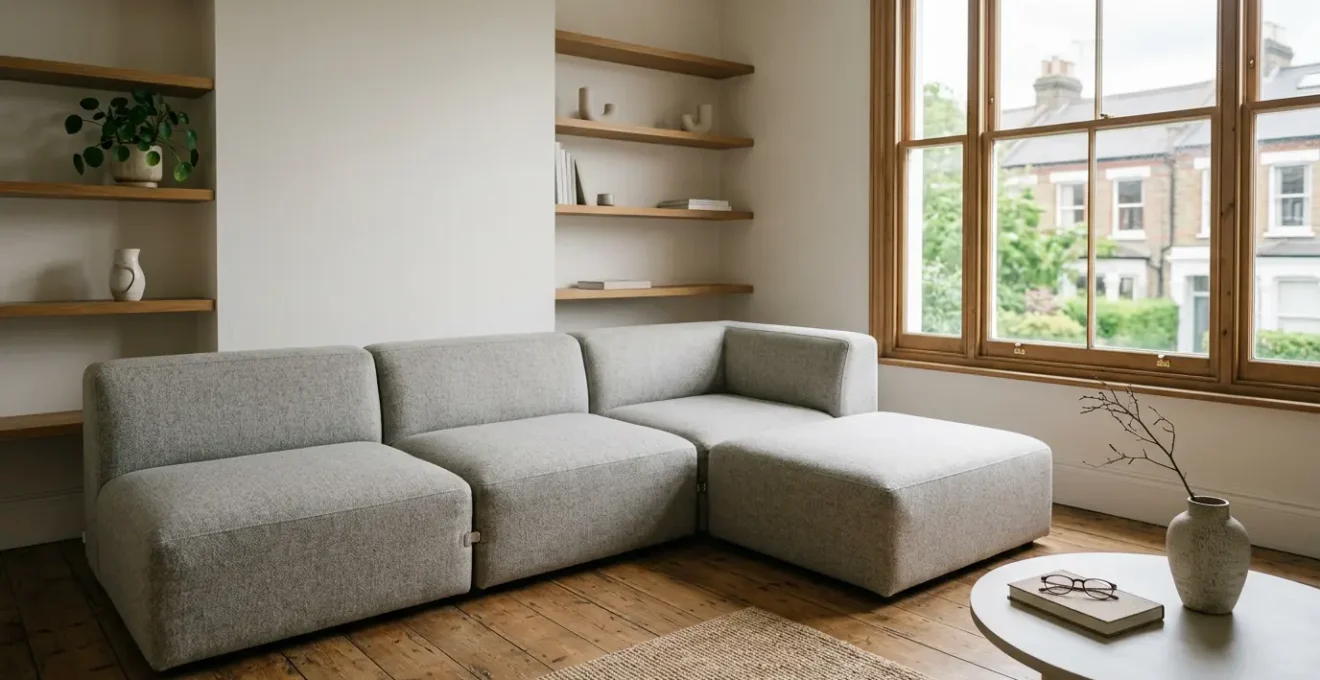
Furnishing a transient London flat isn’t about style; it’s about mastering a system of mobile assets that protects your money and your sanity.
- Your furniture’s true value lies in its durability through multiple moves and its resale price on the UK second-hand market.
- Common rental solutions like adhesive strips and modular units fail due to specific environmental and mechanical stresses you can learn to mitigate.
Recommendation: Stop thinking like a decorator and start acting like an asset manager for your home, focusing on durability, liquidity, and deposit-risk mitigation.
For the young professional in London, moving every six to twelve months is a familiar rhythm. Each new 45-square-metre flat presents the same puzzle: how to make it feel like home without sacrificing your sanity, your weekend, or your tenancy deposit. The standard advice—buy multi-functional furniture, use light colours, and embrace vertical storage—only scratches the surface. It addresses the « small space » issue but completely ignores the brutal reality of the transient renter: the constant cycle of assembly, disassembly, and the financial bleeding from damaged goods and deposit deductions.
Most guides talk about aesthetics. They don’t talk about the physics of why flat-pack connectors fail after the third move, or the chemistry of why Command Strips peel paint from walls common in UK properties. They suggest a modular sofa for flexibility but fail to mention that its feet might be creating a direct deposit liability on a wooden floor, or which specific models actually hold their value when you inevitably list them on Gumtree.
But what if the key wasn’t just in choosing flexible items, but in engineering a flexible *system*? This guide reframes the challenge. It’s not about decorating a temporary space; it’s about curating a collection of durable, reconfigurable, and financially liquid assets. We’ll move beyond the platitudes and dive into the mechanics and economics of furnishing for mobility. You’ll learn to assess furniture not just for its looks, but for its resilience to mechanical stress and its value retention. You’ll understand the science behind common rental failures and, most importantly, how to master the exit strategy to get your full deposit back, every time.
This article provides a strategic framework for the hyper-mobile renter. Follow along as we break down the critical decisions you’ll face, from protecting your deposit to making smart, long-term investments in short-term living.
Contents: A Renter’s Manual for Mobile Living
- Why Does Your Modular Sofa Void the Tenancy Deposit on Wooden Floors?
- How to Reconfigure a Sectional Sofa for a Party of 12 in Under 5 Minutes?
- IKEA Söderhamn or Made Mogen: Which Modular Sofa Holds Value After 5 Years?
- The Connector Tightening Mistake That Causes Modular Shelves to Collapse
- When Do UK Furniture Retailers Discount Modular Ranges by Up to 40%?
- Why Did Your Command Strip Fail and Drop a 3 kg Frame on the Floor?
- The Cupboard Chaos Mistake That Undermines Your Minimalist Living Room
- How to Hang a Gallery Wall in a Rented Flat Without Losing Your Deposit?
Why Does Your Modular Sofa Void the Tenancy Deposit on Wooden Floors?
The biggest fear for any UK renter is a deduction from the tenancy deposit. While guidelines often state that carpet indents from furniture are fair wear and tear, deep scratches or gouges on a wooden floor are unequivocally classed as damage. This is where modular sofas, despite their flexibility, create a significant deposit liability. Unlike traditional sofas that distribute weight along a frame, modular units concentrate their entire load onto small, individual feet. On a wooden floor, each foot becomes a point of intense pressure, capable of causing dents and scratches every time the sofa is shifted or sat on heavily.
This risk is magnified by the very nature of modularity. The constant reconfiguration means these pressure points are frequently moved, dragged, or pivoted across the floor surface, increasing the odds of a costly mistake. For a transient renter, this isn’t just a possibility; it’s a statistical likelihood over several tenancies. The solution isn’t to avoid modular furniture, but to mitigate the risk proactively.
Rental decoration experts in the UK have a clear strategy for this. Instead of placing the sofa directly on the wood, they recommend using temporary, removable flooring solutions under the furniture’s footprint. Interlocking rubber tiles or a low-profile, non-slip mat system can be placed under the sofa area. These solutions are designed to absorb the point-load pressure, provide a protective barrier, and can be completely removed without a trace when you move out. It’s a small upfront investment that effectively neutralises a major financial risk, turning your sofa from a liability into a worry-free asset.
How to Reconfigure a Sectional Sofa for a Party of 12 in Under 5 Minutes?
A modular sofa’s superpower is its adaptability. It can be a sprawling L-shape for a quiet night in, then transform into separate seating pods for a party. However, the promise of « easy reconfiguration » often meets the harsh reality of heavy lifting and confusing connectors. The difference between a five-minute shuffle and a 30-minute wrestling match lies in technique and preparation, not brute force. True mastery of systemic modularity means having a plan before you move a single piece.
The key is to treat it like a choreographed dance, not a puzzle. The most efficient workflows minimise lifting and maximise sliding. Before you begin, create a « playbook » with 2-3 of your favourite layouts sketched out. This eliminates decision-making under pressure. When it’s time to reconfigure, follow a simple, repeatable process:
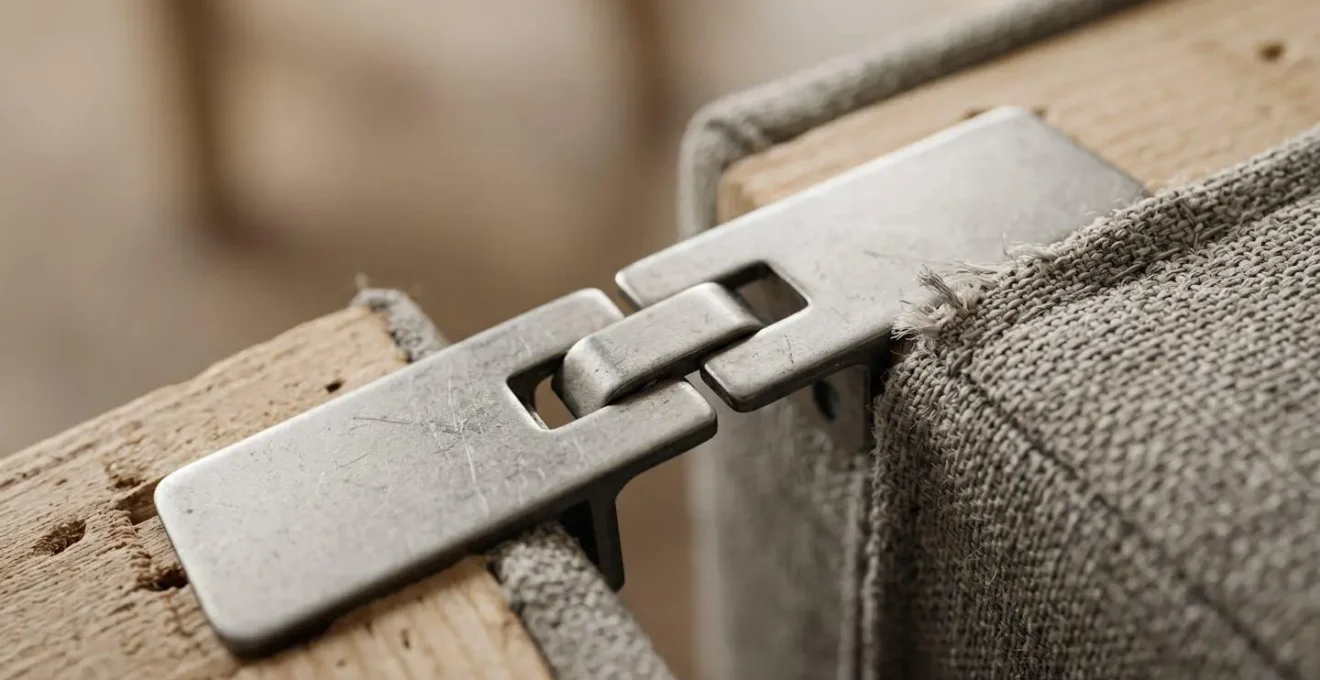
As the image shows, the connection mechanism is the heart of the operation. Understanding how your specific connectors work is vital. The most effective technique for heavy modules involves furniture sliders or even an old blanket placed under the feet. This allows you to pivot and slide sections into place with minimal effort. This process turns a two-person job into a manageable one-person task.
- Clear the Zone: First, remove all accessories—rugs, the coffee table, lamps—to create an unobstructed workspace.
- Pivot, Don’t Lift: Place sliders under the feet of the heaviest corner modules. Use these as pivot points to swing sections around rather than lifting them.
- Master Your Connector: Apply the ‘Pivot & Slide’ technique for C-clip connections. For drop-in brackets, the ‘Lift & Place’ method is unavoidable but should be reserved for lighter modules.
- Connect and Check: Once in position, engage the connectors firmly. Always perform a quick stability check by pushing on the joined sections before allowing anyone to sit down.
IKEA Söderhamn or Made Mogen: Which Modular Sofa Holds Value After 5 Years?
For a transient renter, a sofa is not a « forever » purchase; it’s a medium-term asset. Therefore, its purchase should be evaluated like an investment, considering not just the upfront cost but its depreciation and resale potential. This concept of asset liquidity is paramount. When you move to a new flat with a different layout, will you be able to sell your sofa quickly and for a reasonable price on platforms like Gumtree or Facebook Marketplace? The answer often lies in the sofa’s design, brand reputation, and ecosystem of available parts.
A comparison between two popular UK choices, the IKEA Söderhamn and the now-discontinued Made.com Mogen, provides a clear lesson in long-term value. While both offer modularity, their underlying construction and market presence lead to vastly different outcomes over a five-year period of frequent moves and reconfigurations. The key factors are the durability of the connection system and the availability of replacement parts, especially covers.
As a detailed comparative analysis reveals, the robustness of the connection system and the accessibility of affordable replacement covers are the two most critical factors determining a modular sofa’s long-term functional and financial value for a renter.
| Comparison Factor | IKEA Söderhamn | Made Mogen |
|---|---|---|
| Connection System | Metal-on-metal bolt system (robust for frequent disassembly) | Clips/brackets system (less durable under repeated reconfiguration) |
| Replacement Cover Availability (UK) | Wide range, readily available, affordable third-party options | Limited to brand-specific covers, higher cost, potential discontinuation risk |
| Second-Hand Market Liquidity | High volume of listings on Gumtree/Facebook Marketplace indicating strong resale market | Lower listing volume, niche appeal, slower resale turnover |
| Cost-per-Reconfiguration Durability | Designed for repeated assembly/disassembly with minimal connector wear | Connectors may loosen or degrade faster with frequent reconfiguration |
| 5-Year Functional Value | Higher due to component replaceability and lower long-term maintenance cost | Lower as single stain or damaged module may require replacing entire unit |
The Connector Tightening Mistake That Causes Modular Shelves to Collapse
Flat-pack furniture, the transient renter’s best friend, is also susceptible to a critical flaw: mechanical fatigue. The convenience of being able to assemble and disassemble shelving units or cupboards comes at a cost to their structural integrity. Each time a screw is driven into particleboard, it creates a new path of stress. The most common and catastrophic mistake renters make is over-tightening these connectors, believing that tighter equals stronger. The opposite is true.
Over-tightening a screw into particleboard crushes the wood fibres, creating a weak point that fails later under a dynamic load, not just static weight.
– Furniture assembly expert analysis, Family Handyman furniture reinforcement guide
This single act of crushing the wood fibres permanently compromises the joint. When the shelf is later loaded with books or moved to a new flat, this weak point is where failure begins. The screw loosens, the joint wobbles, and eventually, the entire structure can collapse. This isn’t a defect in the furniture; it’s a failure in assembly technique. To preserve the life and safety of your modular furniture, you must adopt the mindset of a mechanic, not just a builder.
The science backs this up emphatically. A 2024 scientific study on furniture joint mechanics provided definitive proof: properly torqued joints showed double the withdrawal resistance of over-tightened ones. The study highlighted two crucial practices for long-term stability. First, tighten screws in a star pattern (like changing a car tyre) to distribute stress evenly and prevent warping. Second, and most importantly for renters, re-torque all connectors about one month after the initial assembly. Materials naturally compress and settle over time, a process known as ‘creep’, which causes initial tightness to loosen. This one-month follow-up is essential to prevent long-term failure and extend the life of your furniture across multiple moves.
When Do UK Furniture Retailers Discount Modular Ranges by Up to 40%?
Acquiring your flexible furniture system at the lowest possible cost is a cornerstone of maximising its asset liquidity. Paying full price is a rookie mistake when the UK retail cycle for furniture is so predictable. Retailers operate on a seasonal schedule, and timing your purchase to coincide with major stock clearances can save you hundreds of pounds, drastically lowering the initial investment you need to recoup upon resale. For modular ranges, these discounts can be particularly steep as retailers look to offload specific colours or configurations.
The two most significant periods for deep discounts are the post-Christmas January sales and the August Bank Holiday sales. An analysis of major UK furniture retail cycles confirms these are the key moments when stores aggressively clear out old stock to make way for new season catalogues. However, a truly strategic shopper can find deals beyond these two windows by understanding the underlying retail logic.
To turn this knowledge into actionable savings, you need a proactive strategy. Waiting for the sale to start is often too late, as the best deals on modular components can sell out quickly. Here’s how to time your purchase like a pro:
- Track « End of Season » Sales: In February and August, look for clearance deals on specific, often less popular, colours and finishes. The core modules will still be available for future expansion.
- Target « New Catalogue » Transitions: The deepest discounts, often up to 40%, appear in January and September on entire ranges that are being discontinued. This is a higher-risk, higher-reward strategy, as you won’t be able to buy matching modules later.
- Negotiate on Ex-Display Models: Towards the end of a sales period, visit large UK stores like Heal’s or Barker & Stonehouse and inquire about ex-display modular sets. They are often sold with a significant additional discount.
- Use Price-Tracking Tools: Install a browser extension to monitor the price of your desired sofa 4-6 weeks before a major sale. This will help you identify genuine discounts versus inflated « original prices. »
Why Did Your Command Strip Fail and Drop a 3 kg Frame on the Floor?
Command Strips are touted as the renter’s saviour—a damage-free way to personalise walls. Yet, many renters have experienced the sudden, heart-stopping crash of a fallen picture frame, often followed by the discovery of peeled paint. The common assumption is a faulty strip or exceeding the weight limit. However, the real culprit is often a predictable environmental failure, where the adhesive’s chemical properties are compromised by the conditions of a typical UK home.
The synthetic rubber adhesive used in these strips is highly sensitive. According to adhesive engineering analysis, its performance degrades significantly outside a specific operational window. The adhesive softens above 40°C and becomes brittle below 10°C. More critically for the UK climate, high humidity introduces moisture between the strip and the wall, preventing a proper bond. A strip applied on a cold, damp winter wall or in a poorly ventilated room is primed for failure from the start.

This environmental weakness is compounded by a chemical incompatibility with modern paint formulas common in the UK. As rental decoration specialists point out, the very paints designed for durability and easy cleaning are the worst surfaces for adhesives.
Modern ‘wipeable’ or ‘scrubbable’ matt paints contain vinyl or acrylics that adhesives cannot properly bond to, representing a silent killer for Command Strips in UK homes.
– UK rental decoration specialist, Command Strips application guide for UK paint types
The smooth, non-porous finish of these paints offers very little for the adhesive to « grip. » This means that even with perfect surface preparation and staying within the weight limits, the bond is inherently weak and destined to fail under the subtle, constant pull of gravity. The strip doesn’t just fail; it was never truly secure.
The Cupboard Chaos Mistake That Undermines Your Minimalist Living Room
You’ve curated a minimalist living room. The surfaces are clear, the lines are clean, and a sense of calm prevails. But behind one particular cupboard door lies the truth: a chaotic avalanche of items crammed into every available inch. This « doom cupboard » or its cousin, the « chairdrobe, » is the pressure point where a minimalist aesthetic collapses. The mistake is believing that minimalism is about having less; in reality, it’s about having a robust and proactive system for what you own. Out of sight is not out of mind—it’s a decision postponed, and that deferred chaos erodes the very tranquility you seek.
Simply buying more storage boxes is a reactive solution that only conceals the problem. The true, long-term fix is to shift from reactive tidying to a proactive storage philosophy. It’s not about finding a place for everything you have, but about only having things for which a place already exists. This requires a few disciplined principles to create a state of perpetual order, rather than constantly fighting back the tide of clutter.
Adopting this systemic approach transforms storage from a problem into a solved equation. Follow these principles to eliminate chaos at its source:
- Implement the ‘Storage Pre-allocation’ Rule: Before you buy any new item, you must physically identify its exact, empty storage spot. If no such spot exists, you cannot purchase the item. This is the golden rule.
- Establish a Daily ‘Reset Ritual’: Dedicate five minutes every evening to clearing crisis zones. The goal is to make small, consistent decisions to prevent accumulation, rather than facing a massive sorting task later.
- Unify Your Storage Palette: Use a strict palette of only 2-3 uniform container types (e.g., the same model of box or basket) for all visible and concealed storage. This eliminates « visual noise » and creates calm even inside cupboards.
- Conduct Proactive Audits: Replace the « One In, One Out » rule with a monthly storage capacity audit. Proactively assess your cupboards to prevent accumulation before it even begins.
- Calm Open Shelving: Use brandless, uniform storage solutions inside glass cabinets or on open shelves. Mismatched containers create sensory clutter; uniformity creates visual peace.
Key Takeaways
- Think Like an Investor: Evaluate all furniture based on its durability for reassembly and its resale value on the UK second-hand market. This is its true asset liquidity.
- Respect the Physics: Understand that flat-pack furniture and adhesives fail due to specific mechanical and environmental stresses. Proper assembly and application techniques are not optional.
- Master the Exit Strategy: Your primary goal as a renter is to protect your deposit. Prioritise damage-free installation methods and learn the professional techniques for invisible repairs.
How to Hang a Gallery Wall in a Rented Flat Without Losing Your Deposit?
The gallery wall is a fantastic way to inject personality into a bland rental, but for the transient renter, it’s a minefield of deposit liability. The common approach—using a dozen individual Command Strips—is deeply flawed. As we’ve seen, these strips are prone to failure, and each one represents a potential point of paint-peel damage. A gallery wall of 10 frames creates 10-20 individual risks to your deposit. A superior strategy focuses on consolidating damage into a few easily manageable points, giving you maximum flexibility with minimum risk.
UK rental experts advocate for a much smarter system: the picture ledge. By installing one or two long, narrow shelves, you only need to drill 2-4 holes in total. These ledges then provide a platform where you can arrange, overlap, and swap out dozens of frames of various sizes without ever putting another mark on the wall. This approach concentrates all potential damage into a few screw holes, which are far easier and more reliable to repair than a swath of peeled paint from failed adhesives. It’s the ultimate rental-friendly solution, offering infinite creative freedom for a fixed, minimal, and easily reversible impact on the property.
The success of this strategy, however, hinges on your ability to make those 2-4 screw holes vanish without a trace before your final inspection. Mastering the art of invisible wall repair is the single most valuable skill a UK renter can possess. It’s not about just slapping on some filler; it’s a precise, multi-step process.
Your 5-Step Plan for Invisible Wall Repairs
- Fill with the Right Material: Use Polycell Deep Gap Polyfilla, specifically designed for UK plasterboard. Apply it so it’s slightly proud of the surface to account for shrinkage as it dries.
- Create a Flush Finish Without Sanding: Press a damp cloth flat against the wet filler and the wall. This smooths the filler flush with the wall’s texture, eliminating the need for dusty sanding that creates a noticeable smooth patch.
- Cure Completely: Allow the filler to cure for at least 2-4 hours. Painting too early will cause it to crack and the repair will be obvious. Patience is critical.
- Match the Paint: Purchase a small tester pot of a generic white emulsion like Dulux Matt. Apply two thin coats over the repair rather than one thick, globby one.
- Feather the Edges: Use a small foam roller to gently « feather » the paint edges 2-3 inches out from the repair. This blends the new paint seamlessly into the existing wall finish, making it invisible to the naked eye.
Embrace this strategic mindset. By viewing your rented flat not as a temporary stop, but as a system to be managed, you can transform the stress of moving into a smooth, cost-effective process. Start engineering your mobility today.