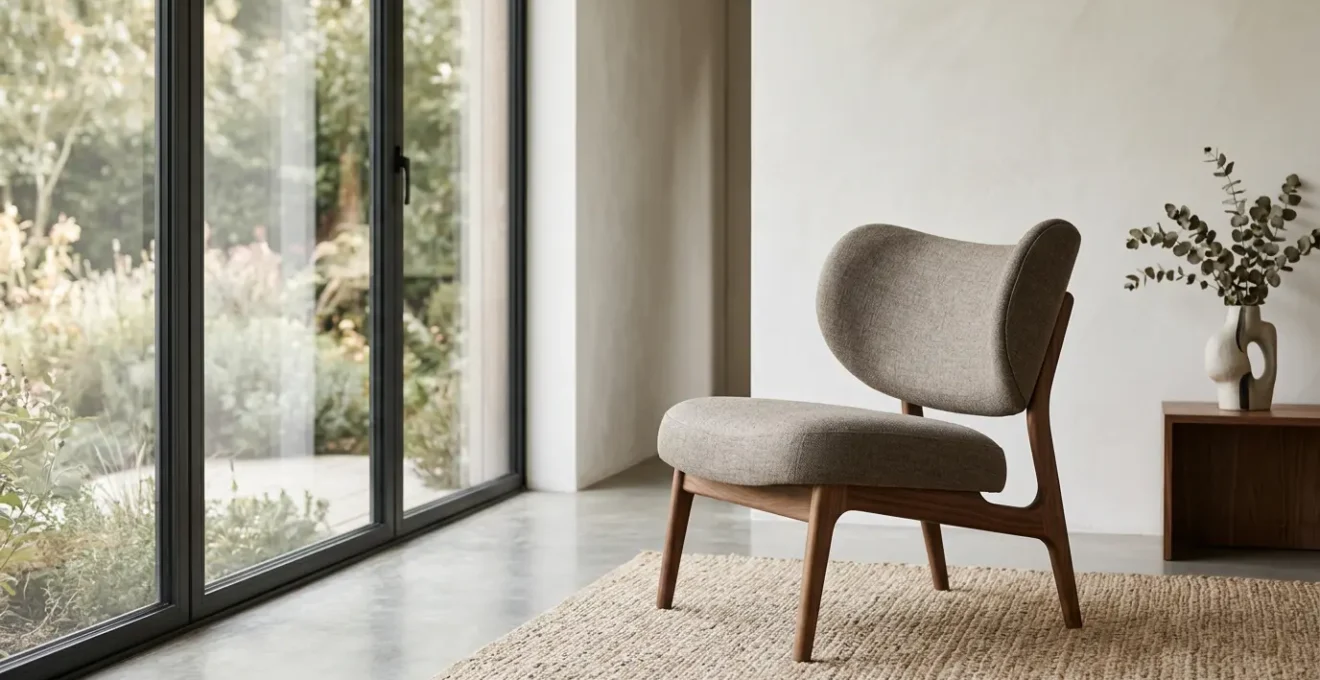
The belief that a statement chair must sacrifice comfort for style is a design myth.
- True comfort is not about softness; it’s about ergonomic science, specifically how a chair distributes pressure across your body.
- Visual impact is determined less by a chair’s physical size and more by its « visual weight » and its relationship to the space around it.
Recommendation: Prioritise chairs with proven ergonomic geometry and a solid hardwood frame, then use material and placement to achieve your desired sculptural effect.
The search for the perfect statement chair often feels like a compromise. You find a piece with breathtaking sculptural lines, an object of art that promises to define your living room. Yet, the unspoken fear lingers: will this beautiful creation be a torture device after the first hour of a good book or conversation? Many homeowners resign themselves to the idea that iconic design and long-term comfort are mutually exclusive, relegating their « statement » piece to a purely ornamental role.
The common advice—to measure your space and match your décor—barely scratches the surface. It addresses the chair as a decorative object but ignores its primary function as a piece of engineering for the human body. This approach is why so many stunning chairs end up as expensive, unused sculptures in the corner of a room.
But what if the secret to a successful statement chair wasn’t a choice between form and function, but an understanding of how they intersect? The key isn’t to sacrifice one for the other, but to decode the hidden principles of ergonomic design and material science. It’s about learning to see beyond the initial aesthetic and identify the markers of a chair engineered for both visual impact and sustained comfort.
This guide will walk you through the essential engineering and design principles that separate a fleeting aesthetic from a lifelong investment. We will explore the science of pressure distribution, the physics of materials, and the spatial dynamics that allow a chair to command a room without overwhelming it, ensuring your choice feels as magnificent as it looks.
To help you navigate these crucial considerations, this article is structured to answer the most pressing questions homeowners face. From understanding why certain designs fail ergonomically to making smart choices about materials and placement, each section provides an expert framework for your decision.
Summary: Finding the Perfect Balance of Sculptural Form and Ergonomic Function
- Why does your Wishbone chair look stunning but hurt your back after dinner?
- How to choose leather that develops patina instead of cracks over 10 years?
- Swivel base or four legs: which chair style works best in a small UK living room?
- The oversized armchair mistake that makes your reception room feel cramped
- When should you reupholster a vintage chair instead of buying new?
- The sofa-sizing mistake that blocks 40% of UK living room doorways
- Why does your designer chair look cramped despite a large living room?
- How to balance a sculptural coffee table with functional seating in 20 m²?
Why does your Wishbone chair look stunning but hurt your back after dinner?
Many iconic chairs, like the Wishbone, were designed as dining chairs, intended for the upright posture of a meal, not for hours of relaxed lounging. The discomfort you feel after an extended period isn’t a design flaw; it’s a mismatch of purpose and ergonomics. True long-term comfort hinges on a scientific principle: pressure distribution. When you sit, your body weight concentrates on your ischial tuberosities (your « sit bones »), creating high-pressure hotspots that lead to fidgeting and pain.
A well-engineered lounge chair is designed to counter this. It uses a combination of seat angle, backrest contour, and material science to spread your weight over a much larger area, including the sacral-pelvic, thoracic, and lumbar regions. As research from Herman Miller demonstrates, chairs with advanced postural support reduce these pressure peaks, creating what their team describes as « a sensory experience of flotation. » This is the core difference: a dining chair supports an active posture, while a true lounge chair cradles a resting one.

Look for a seat pan that is deep enough to support your thighs without pressing into the back of your knees and a backrest that offers substantial lumbar support. The angle between the seat and back should be greater than 90 degrees, typically around 105 to 110 degrees, to open your posture and relieve spinal compression. It is this specific ergonomic geometry, often invisible to the untrained eye, that separates a two-hour chair from a twenty-minute one.
How to choose leather that develops patina instead of cracks over 10 years?
The dream of a leather chair that ages gracefully, developing a rich, unique patina, depends entirely on choosing the right type of leather from the start. The key distinction lies between full-grain/aniline leather and corrected-grain/pigmented leather. Full-grain leather is the highest quality hide, retaining its natural surface, including pores and minor imperfections. It’s treated with soluble aniline dyes, which soak into the material without coating the surface. This allows the leather to breathe, absorb oils from use, and develop a beautiful patina over time.
In contrast, corrected-grain leather has had its surface sanded down to remove imperfections and then coated with a layer of synthetic pigments and protectants. While this makes it more uniform and initially more resistant to stains, it seals the surface. This plastic-like coating prevents the leather from breathing and absorbing oils. Over years of use, as the material flexes, this rigid topcoat is what cracks and peels, revealing the less attractive material underneath. It will never develop a true patina.
To ensure you’re investing in a chair that will age beautifully, ask for « full-grain » or « aniline » leather. It will feel softer, warmer to the touch, and you may even see the natural grain of the hide. While it requires more care to protect it from spills, its ability to mature with you is what creates a truly personal and valuable piece of furniture. Proper maintenance is crucial to nurturing this process.
Swivel base or four legs: which chair style works best in a small UK living room?
When furnishing a smaller space, every square centimetre counts. Given that, the average living room in newly built UK houses is 17.1 square meters, choosing furniture that maximises functionality is paramount. The debate between a swivel base and traditional four-legged chair isn’t just aesthetic; it’s about a crucial design concept known as the « dynamic footprint. »
A chair’s physical footprint is the floor space it occupies when static. However, its dynamic footprint includes the extra circulation space required to access and use it. A four-legged chair often requires a larger clear zone around it, as you need to pull it out to sit down or manoeuvre your body around it. In a tight corner or a narrow room, this can create awkward bottlenecks and make the space feel more cluttered than it is.
A swivel-base chair, by contrast, has a significantly smaller dynamic footprint. You can approach it from a narrower angle and simply rotate into position. This makes it exceptionally efficient for compact living rooms, multi-purpose spaces, or creating a reading nook in a bay window. A swivel mechanism allows a chair to face the sofa for conversation, turn towards the window for a view, or angle towards the television, all without being physically moved. This functional flexibility makes the most of limited square footage, making the swivel base a clear winner for most small UK homes.
The oversized armchair mistake that makes your reception room feel cramped
One of the most common design errors is confusing a chair’s physical size with its perceived size. Homeowners often choose a large, blocky armchair hoping for a grand statement, only to find it visually suffocates the room. The solution lies in understanding the difference between physical footprint and visual weight. Physical footprint is the actual area a chair covers, while visual weight is how heavy and imposing it *feels* in the space.
A chair on slim legs can have a large physical footprint but low visual weight, preserving a sense of space.
– Interior Design Expert, Visual Weight vs Physical Footprint Concept
A chair with high visual weight typically sits directly on the floor or has a heavy, solid base. It blocks light and sightlines, making the room feel smaller. Conversely, a chair elevated on slim legs, even if its seat is generously proportioned, has low visual weight. Because you can see the floor beneath it, light can pass under and around it, creating a sense of openness and airiness. This allows you to have a comfortable, large-seated chair that doesn’t feel bulky.
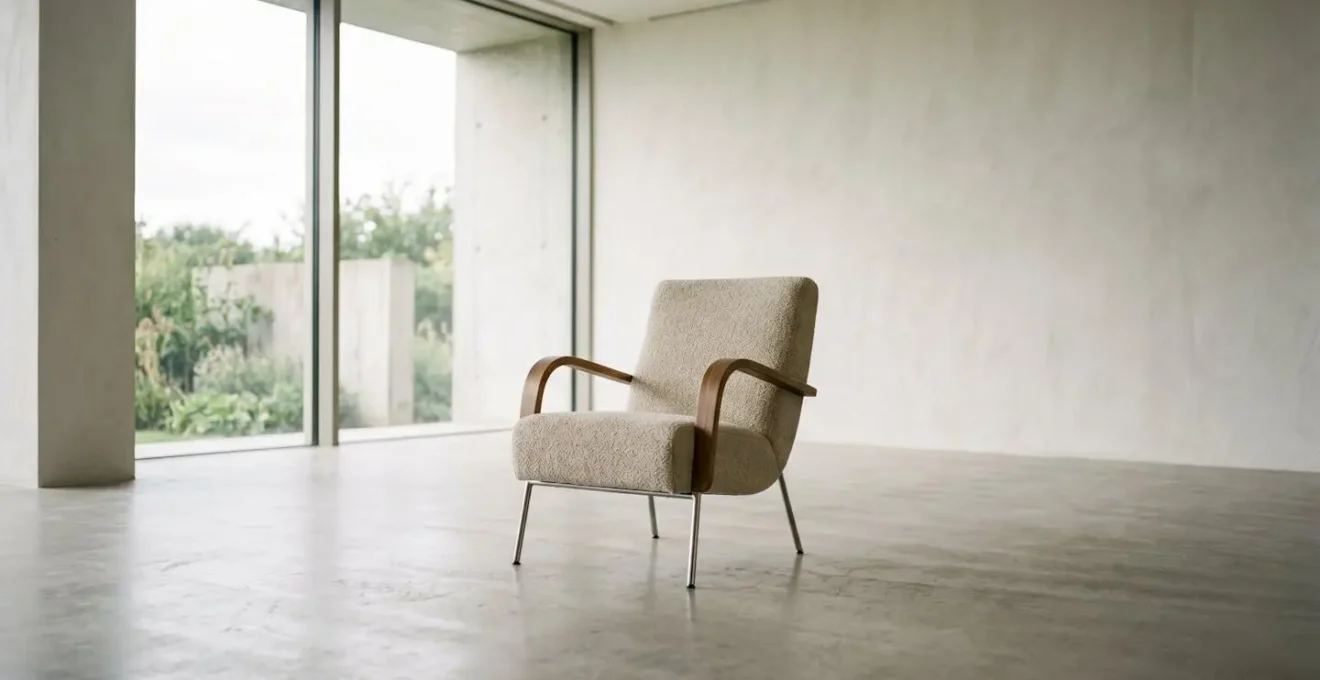
This principle is all about preserving negative space—the « breathing room » around your furniture. A visually light chair honours this negative space, allowing the architecture of the room to remain visible. When selecting your chair, pay as much attention to its legs and base as you do to its upholstery. Opting for slender legs, a cantilevered base, or lighter-coloured materials can make a substantial chair feel elegant and integrated rather than heavy and intrusive.
When should you reupholster a vintage chair instead of buying new?
Finding a vintage chair with a unique silhouette can feel like striking gold, but worn-out fabric or flattened cushions can present a dilemma. The decision to reupholster or replace hinges on a cost-benefit analysis that goes beyond the price tag. While the cost to reupholster a chair ranges from $50 to $2,000, with a national average around $800 in the US, the real value is determined by the chair’s hidden qualities: its frame and its design integrity.
The most important factor is the frame quality. Older furniture was often built to last, using solid hardwood (like oak, maple, or walnut) with robust joinery (mortise-and-tenon or dowel joints). If you pick up the chair and it feels heavy, solid, and doesn’t wobble, you likely have a high-quality frame that is far superior to the particleboard and staples found in many contemporary mass-market pieces. Reupholstering a chair with « good bones » is an investment in longevity.
This framework, drawing from expert advice, can guide your choice. As a comparative analysis from industry professionals at HomeGuide shows, the decision becomes clearer when you weigh these factors systematically.
| Decision Factor | Reupholster (Recommended) | Buy New (Consider Instead) |
|---|---|---|
| Frame Quality | Solid hardwood frame, tight joints, no wobbling | Particleboard frame, loose joints, structural damage |
| Design Value | Iconic shape, family heirloom, unique vintage design | Generic mass-market design, easily replaceable style |
| Cost Comparison | $300-$1,100 for quality reupholstery with custom fabric | $1,000+ for comparable quality new furniture |
| Comfort Customization | Upgrade foam density, replace webbing, customize support | Limited to manufacturer’s specifications |
| Sustainability | Diverts from landfill, preserves quality materials | Adds to furniture waste, often lower construction quality |
Furthermore, reupholstering offers a level of customisation that buying new rarely does. You can select the exact fabric, colour, and pattern to perfectly match your interior. More importantly, you can work with the upholsterer to upgrade the comfort, specifying higher-density foam, replacing worn webbing, or adding extra padding. This allows you to transform a piece with timeless style into a chair with modern, personalised comfort—a winning combination.
The sofa-sizing mistake that blocks 40% of UK living room doorways
While the title references sofas, the principle applies equally to any large piece of furniture, including a substantial statement armchair. One of the most heartbreaking—and entirely avoidable—design mistakes is purchasing a piece that simply won’t fit through the door. Measurements on a floor plan are deceptive; they don’t account for tight turns in hallways, low ceilings on staircases, or narrow door frames. A chair’s height, width, and depth must be considered in relation to every single access point.
The problem is that we perceive space in two dimensions when planning, but furniture exists in three. A chair’s diagonal measurement (from the top back corner to the bottom front corner) is often its largest dimension and the one that gets caught on door frames. In many UK homes, especially period properties with non-standard doorways, this can turn delivery day into a disaster.
To prevent this, you must think like a removal professional. Before you even consider purchasing, employ a foolproof technique to test the chair’s journey from the street to its final position in your living room. The « Cardboard Mock-up » method is a simple but powerful way to experience the volume of the furniture in your actual space.
Action plan: The cardboard mock-up method
- Measure the exact dimensions (width, depth, height) of the statement chair you are considering.
- Collect cardboard boxes or large sheets and construct a simple 3D box model representing the chair’s total volume.
- Physically manoeuvre this cardboard mock-up through every access route: front door, hallways, stairwells, and interior doorways.
- Place the mock-up in its intended final location to assess its scale and impact on walkways and sightlines.
- Live with the mock-up for at least 24 hours to get a true feel for its presence before committing to the purchase.
Why does your designer chair look cramped despite a large living room?
It’s a perplexing scenario: you have a spacious living room with high ceilings, yet the beautiful designer chair you’ve placed in it looks small, lost, and strangely out of place. This common issue rarely has to do with the chair’s width or depth. Instead, it’s often a problem of verticality and anchoring. A chair can appear « cramped » or disconnected not because the room is too small, but because it fails to relate to the room’s grander architectural scale.
Case Study: Scale and Proportion Mismatch in High-Ceiling Spaces
Interior design experts identify that chairs appearing diminished in large rooms often suffer from a verticality mismatch. Low-backed chairs in rooms with high ceilings (e.g., 3m or more) create a jarring disproportion in scale. The visual energy of the chair is concentrated near the floor, making it feel disconnected from the vast vertical space above. The solution involves matching the chair’s vertical presence to the ceiling height. Tall wingback chairs, armchairs with high, slender backs, or even placing a tall floor lamp next to a lower chair helps draw the eye upward, connecting the furniture to the room’s architecture and preventing the « lost island » effect.
The solution is to create a purposeful « vignette » or zone that anchors the chair to its surroundings. Instead of letting it float in an ocean of floor space, ground it. Place the chair on a small area rug to define its territory. Pair it with a side table of an appropriate height and a floor lamp that adds vertical interest. This grouping creates a self-contained, intentional composition. It tells the eye, « This is a deliberate space—a reading nook, a conversation spot. »
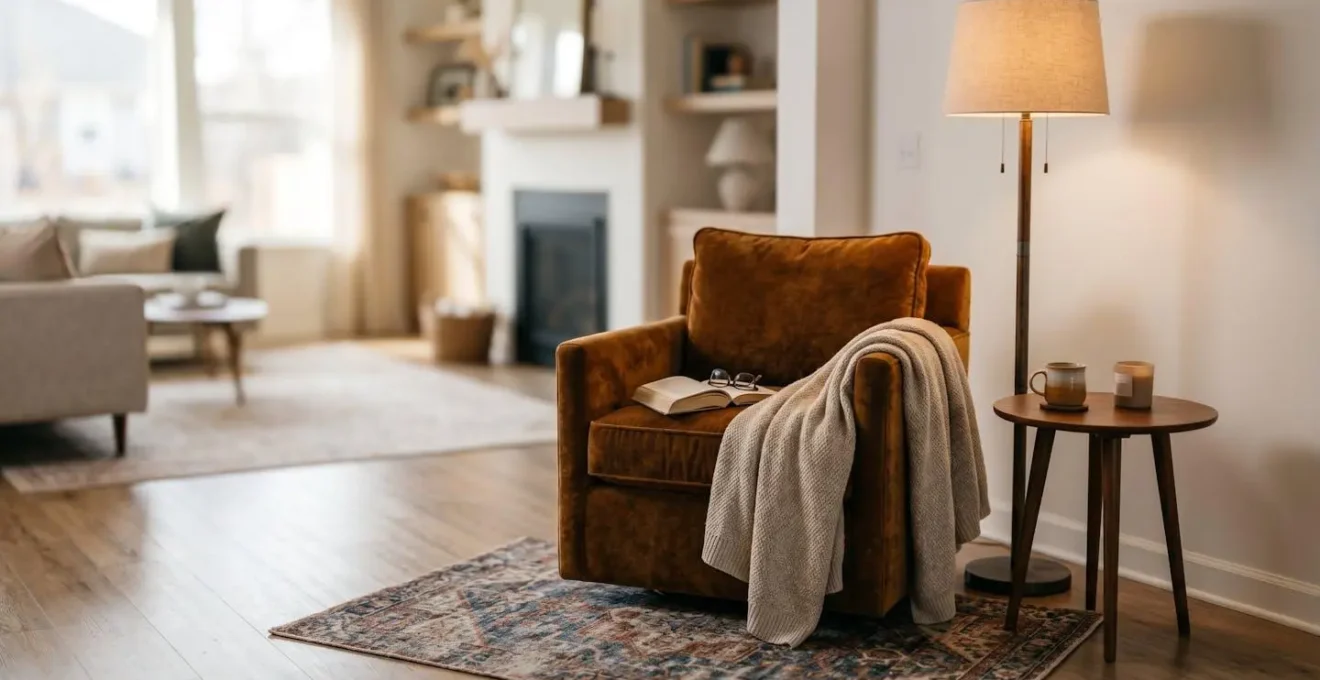
By anchoring your chair with complementary pieces, you give it context and purpose. This not only solves the problem of it looking lost but also elevates the entire room’s design, transforming an isolated object into an integrated and inviting feature of your home.
Key takeaways
- Long-term comfort is a science of pressure distribution, not softness. A chair must support your entire frame, not just your sit bones.
- A chair’s perceived size is defined by its « visual weight. » Pieces on slim legs feel lighter and preserve a sense of space, even if they are large.
- In large rooms, a chair needs to be « anchored » with a rug, side table, or lamp to create a purposeful vignette and connect it to the room’s scale.
How to balance a sculptural coffee table with functional seating in 20 m²?
In a moderately sized room of around 20m², the relationship between your statement seating and a sculptural coffee table is critical. When both pieces have strong personalities, they can either compete for attention, creating visual chaos, or they can enter a dialogue that elevates the entire space. The key to achieving this balance is to think in terms of visual weight and material relationships. You can aim for either harmony or a productive tension.
Material harmony is achieved by pairing pieces that share a common element. For example, a bouclé armchair with walnut legs will naturally harmonise with a dark walnut coffee table. This creates a cohesive, calm, and unified look. This approach works well when you want the room to feel serene and pulled-together.
Alternatively, you can create a more dynamic and interesting space by pairing materials in tension. This involves deliberately contrasting visual weights. If you have a heavy, monolithic coffee table made of travertine or concrete, balance it with a visually light chair—one on slim metal legs, with a caned back, or in a light-coloured fabric. Conversely, if your coffee table is light and transparent (glass or acrylic), you can afford to anchor the space with a more substantial, grounded armchair in rich leather or with a solid wood frame. This interplay of heavy and light creates a sophisticated visual balance.
The following matrix provides a quick guide to pairing common coffee table materials with complementary seating to achieve either harmony or tension.
| Coffee Table Material | Visual Weight | Balancing Chair Style | Material Relationship |
|---|---|---|---|
| Travertine / Stone | Heavy, Monolithic | Chair on slim legs, caned back, light upholstery | Material Tension (heavy table + light chair) |
| Glass / Acrylic | Light, Transparent | Substantial leather armchair, solid wood frame | Material Tension (light table + substantial chair) |
| Dark Walnut Wood | Medium-Heavy | Bouclé upholstery on walnut legs | Material Harmony (shared wood species) |
| Concrete | Heavy, Industrial | Soft velvet chair, brass or gold-tone legs | Material Tension (industrial + luxury) |
| Natural Oak | Medium, Warm | Natural linen upholstery, oak or light wood frame | Material Harmony (shared organic warmth) |
Ultimately, selecting a statement chair that is both beautiful and comfortable requires a shift in perspective. Move beyond surface-level aesthetics and learn to read a chair’s ergonomic language. By applying these principles of pressure distribution, visual weight, and spatial anchoring, you can invest with confidence, knowing your chosen piece is not just a fleeting trend but a perfectly engineered addition to your home that will bring you joy and comfort for years to come.