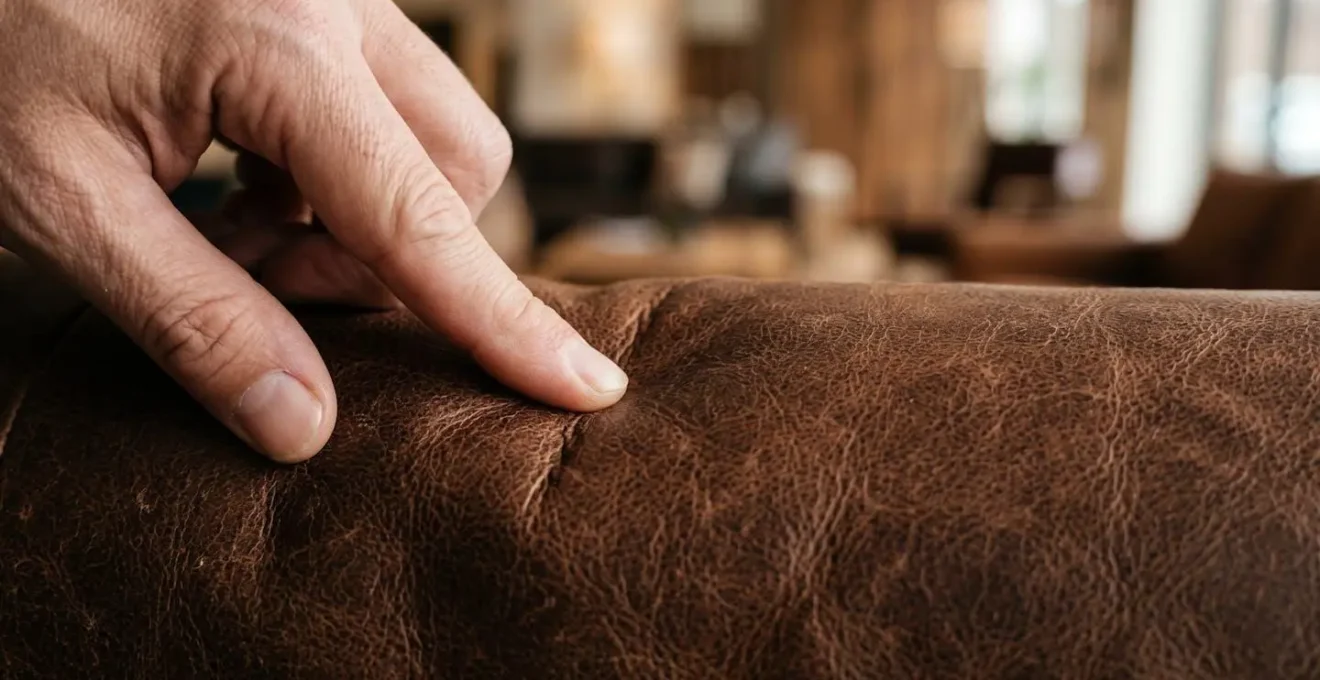
Contrary to showroom claims, the ‘Genuine Leather’ tag often hides the lowest quality. True value is found in the hide’s natural story, not its marketing label.
- Full-grain leather proudly displays imperfections like scars and pores; this is the ultimate sign of its authenticity and strength.
- Your nose and hands are the best tools: premium leather has a rich, organic scent and a supple feel, while fakes smell of chemicals and feel like plastic.
Recommendation: Before checking the price tag, perform the ‘pull-up’ test by pinching the leather. If it lightens in colour, you’re likely holding a high-quality, oil-rich hide.
Stepping onto a polished UK showroom floor can feel like entering a minefield of terminology. You’re surrounded by the inviting scent of new furniture, but also by salespeople and labels whispering terms like ‘bonded’, ‘genuine’, ‘aniline’, and ‘full-grain’. The fear is palpable: making a four-figure investment in a sofa that starts cracking and peeling in two years because you mistook clever marketing for true quality. Most advice centres on reading the tag, but the truth is, the most misleading terms are often printed with the most confidence.
The common wisdom to « check the label » is precisely why so many buyers are disappointed. A « genuine leather » stamp, for instance, often denotes one of the lowest grades of hide, sanded and coated to hide its poor origins. But what if the secret to identifying premium leather wasn’t in reading, but in a series of simple sensory tests? What if your own hands, eyes, and nose were the most sophisticated tools you could bring to the showroom?
This guide abandons the marketing jargon and empowers you with a form of sensory forensics. It will train you to identify the subtle clues that separate a hide destined to develop a beautiful patina from one destined for the landfill. We’ll explore the science behind the scent, the feel of a durable seam, and the critical environmental factors—like the placement of a common household radiator—that can make or break your investment. You will learn to see imperfections not as flaws, but as hallmarks of quality, and walk away with the confidence that your new statement piece is built to last a lifetime.
Summary: Your Field Guide to Leather Quality on the Showroom Floor
- Why Does Vegetable-Tanned Leather Smell Richer and Age Better Than Chrome-Tanned?
- How Often Should You Condition a Leather Sofa to Survive UK Winter Heating?
- Aniline or Pigmented Leather: Which Handles a Family With Young Children Better?
- The Radiator Placement Mistake That Cracks Leather Sofas Within 2 Winters
- When Do UK Retailers Stock Fresh-Batch Leather Furniture After Tannery Cycles?
- How to Choose Leather That Develops Patina Instead of Cracks Over 10 Years?
- Why Do Hand-Sewn Seams Look Uneven but Last Twice as Long?
- How to Choose a Statement Chair That Still Feels Comfortable After 2 Hours?
Why Does Vegetable-Tanned Leather Smell Richer and Age Better Than Chrome-Tanned?
The first and most primal test of leather quality happens before you even touch it: the smell. Your nose can instantly distinguish between a product born from artisanal tradition and one from rapid industrial processing. The difference lies in the tanning method. Vegetable-tanned leather, an age-old process using natural tannins from tree bark and plants, is a slow and deliberate craft. In contrast, chrome-tanning uses chromium salts to achieve a rapid result. This fundamental difference in chemistry is something you can literally smell on the showroom floor.
According to leather craftsmanship experts, the chrome tanning process completes in a single day, while vegetable tanning takes months. This extended period allows the natural tannins to fully penetrate the hide, preserving its fibres and imbuing it with a unique character that evolves over time. This is why vegetable-tanned goods develop a rich patina, darkening and softening with use, while chrome-tanned items tend to fade or crack without the same graceful aging process. The scent is your primary clue, as noted by industry specialists.
Vegetable-tanned leather typically has a sweet scent, while chrome-tanned leather has a more chemical smell.
– Von Baer Leather Experts, Chrome Tanned Leather Guide
On the showroom floor, lean in. A rich, earthy, slightly sweet fragrance suggests a vegetable-tanned piece with high patina potential. A sharp, chemical, or synthetic smell is a red flag, indicating a faster, cheaper chrome-tanning process that prioritises speed over longevity.
How Often Should You Condition a Leather Sofa to Survive UK Winter Heating?
Buying a quality leather sofa is only half the battle; protecting it from the unique stresses of a UK home is the other. The biggest threat isn’t spills or sunlight—it’s the dry air created by central heating during the long, damp winters. This moisture-cycle stress dehydrates the leather, drawing out the natural oils that keep it supple and leading to brittleness and cracking. Proper conditioning isn’t a once-a-year task; it’s a strategic response to your home’s environment.
The goal is to maintain a stable level of moisture within the hide. While climate-controlled storage facilities maintain a strict 40-45% humidity to preserve valuables, your living room experiences wild fluctuations. Therefore, a proactive conditioning schedule is crucial. Don’t wait for the leather to look dry; by then, the damage has already begun. Instead, adopt a preventative two-part cycle aligned with the seasons of your heating system.
A simple « touch test » is your best guide between scheduled treatments. Healthy, well-hydrated leather should feel cool and supple. If the surface feels warm, stiff, or has a waxy, unyielding texture, it’s a sign that the oils are depleted and an immediate conditioning session is needed, regardless of the schedule. Think of conditioning not as cleaning, but as replenishing a vital nutrient for your furniture’s long-term health.
Your Action Plan: Optimal Leather Conditioning for the UK Climate
- Early Autumn Prep: Perform the first critical conditioning session just before you typically turn on the central heating. This creates a protective barrier to prepare the leather for the upcoming dry air.
- Late Winter Rescue: The second essential treatment should happen in late January or February, when indoor air is at its driest. This replenishes moisture lost during the peak of the heating season.
- Monitor Humidity: Use a simple hygrometer to keep an eye on your room’s humidity. Aiming for a 40-50% range will significantly reduce the leather’s stress and your conditioning frequency.
- Perform the Touch Test: Between scheduled sessions, regularly touch the leather. If it feels warm, stiff, or makes a slight rustling sound, it’s asking for a condition sooner rather than later.
Aniline or Pigmented Leather: Which Handles a Family With Young Children Better?
This is one of the most critical decisions a buyer faces, as the answer pits aesthetic ideals against practical reality. The choice between aniline and pigmented leather is a choice about lifestyle. Aniline leather is the most natural-looking, dyed exclusively with soluble dyes without a topcoat. It’s incredibly soft and showcases the hide’s natural surface, including pores and scars. It’s a ‘living diary’ that absorbs life’s marks, developing a unique patina. For a household with young children and pets, this diary can quickly become a horror story of stains and scratches.
Pigmented leather, on the other hand, is the workhorse. It has a polymer surface coating containing pigments, which makes it far more durable and resistant to spills, stains, and fading. While it lacks the ultra-soft, natural feel of aniline, it offers peace of mind. A spilt drink can be wiped away with a damp cloth, rather than becoming a permanent part of the furniture’s story. For a family, this often translates to a ‘stress-free playground’ rather than a source of constant anxiety.
The trade-off is clear: the unparalleled beauty and feel of aniline versus the robust, low-maintenance practicality of pigmented leather. The following comparison breaks down their performance in a typical family environment, highlighting how each characteristic impacts daily life.
| Characteristic | Aniline Leather | Pigmented Leather |
|---|---|---|
| Stain Resistance | Low – absorbs liquids within 5 seconds | High – spills wipe away easily with damp cloth |
| Scratch Visibility | Lower – scratches reveal same color throughout | Higher – scratches remove topcoat, revealing different color underneath |
| Maintenance Level | High – requires immediate spill response, conditioning every 2-3 months | Low – conditioning every 6-12 months, delayed cleanup window |
| Cleanup Window | ~5 seconds before liquid absorption begins | Minutes to hours before staining occurs |
| Recommended For | Adult-only households, ‘living diary’ philosophy | Families with children/pets, ‘stress-free playground’ approach |
Ultimately, the « better » leather depends entirely on your tolerance for risk and your definition of a beautiful home. Do you value pristine surfaces or a story written in scuffs and marks? As this detailed performance analysis shows, the right choice aligns your furniture with your life, not the other way around.
The Radiator Placement Mistake That Cracks Leather Sofas Within 2 Winters
In the UK, the radiator is a ubiquitous feature of almost every living room, and it is leather’s silent enemy. The most common and devastating mistake a new leather furniture owner can make is placing their prized sofa too close to a heat source. The constant, direct, dry heat acts like a kiln, systematically robbing the leather of its essential moisture and oils. The result isn’t immediate; it’s a slow-motion disaster that often becomes apparent after the second winter, when fine cracks begin to appear and the leather feels tight and brittle.
This damage is irreversible. Once the protein fibres in the hide have shrunk and cracked from heat exposure, no amount of conditioner can restore their structure. The key is prevention, which involves respecting a critical safety distance. Think of it as creating a « no-go zone » for your furniture around all heat sources, including radiators, fireplaces, and heating vents. Protecting your investment requires spatial awareness and understanding the early warning signs of heat stress.
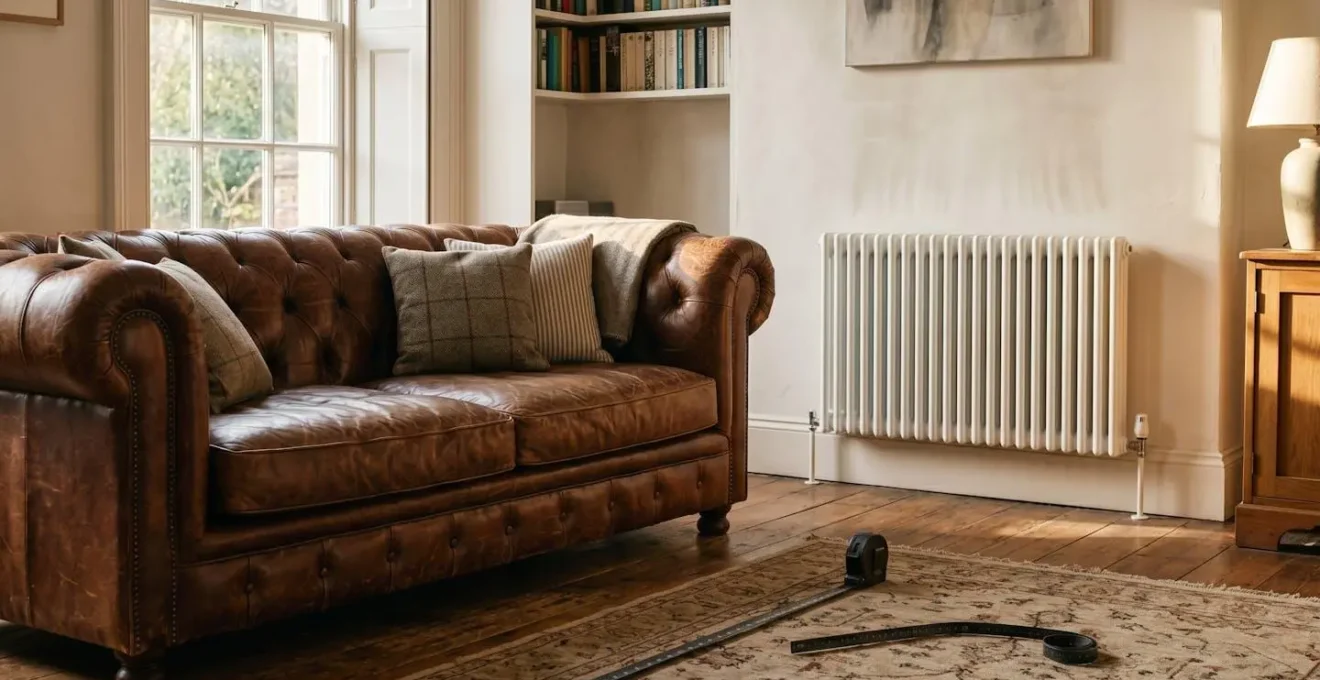
The signs of heat damage are subtle at first. You might notice the leather feels slightly ‘crisp’ or makes a faint rustling sound when you sit down. The colour may also appear ‘ashy’ or lighter in the area closest to the radiator. These are not signs of normal wear; they are the leather’s distress signals, warning you of impending failure. Acting on these signs by moving the furniture or mitigating the heat source is crucial for its survival.
- Maintain a minimum 12-inch (30cm) gap between leather and radiators. A 24-inch gap is even safer.
- If close placement is unavoidable, install a radiator cover that directs heat upwards, away from the furniture.
- A clever alternative is placing a large, leafy plant between the radiator and the sofa; it acts as a natural heat buffer and increases local humidity.
- Pay attention to the early warning signs: leather feeling tight or crisp, a slight rustling sound upon sitting, or a lighter, ashy appearance near the heat source.
When Do UK Retailers Stock Fresh-Batch Leather Furniture After Tannery Cycles?
Chasing a « fresh-batch » leather sofa is a common desire, born from the belief that newer is better. However, the global furniture supply chain is far more complex than a simple « best before » date. There isn’t a single, predictable date when all UK retailers receive fresh stock. Instead, new inventory arrives in waves, dictated by international manufacturing schedules, shipping logistics, and, most importantly, the UK’s own retail calendar.
The key is to think in seasons, not specific dates. Retailers typically clear out old inventory during major sales events. Therefore, the periods immediately following these sales are when new collections are most likely to appear. The two most significant windows for new models to hit the showroom floor are February-March (after the January sales have cleared space) and August-September (in preparation for the crucial pre-Christmas shopping season). These are the times when you are most likely to see entirely new designs and the first units from those production runs.
However, « freshness » in leather is less about the date of manufacture and more about its condition upon arrival. A sofa made six months ago but stored correctly in a climate-controlled warehouse is in better condition than one made last month that sat in a damp shipping container. Instead of asking « How old is this sofa? », a more insightful question for a salesperson is, « When did this particular model or colourway arrive in your store? » This gives you a better sense of how long it has been sitting on the showroom floor, exposed to light and customer traffic, which is a more relevant measure of its immediate condition.
Ultimately, a well-made sofa from a reputable tannery will be stable for years. Focus your forensic skills on the quality of the hide itself—the grain, the smell, the stitching—rather than chasing an elusive manufacturing date. True quality is timeless.
How to Choose Leather That Develops Patina Instead of Cracks Over 10 Years?
The holy grail for any leather aficionado is patina: the beautiful sheen and gradual darkening that develops over years of use, telling the story of its life. Cracking, on the other hand, is the story of a material’s failure. The secret to ensuring one over the other lies in selecting a hide that has the inherent ability to age gracefully. This ability is determined by two factors: the quality of the hide and the type of finish.
First, only full-grain leather—the top layer of the hide with all its natural markings and pores intact—has the robust fibre structure to develop a true patina. Lower grades like ‘top-grain’ or ‘genuine leather’ have had their surfaces sanded away, removing the strongest fibres and making them more prone to cracking. Look for natural imperfections: small scars, insect bites, or variations in texture are not flaws, but hallmarks of authentic full-grain leather. They are proof that you are looking at an unaltered, strong hide.
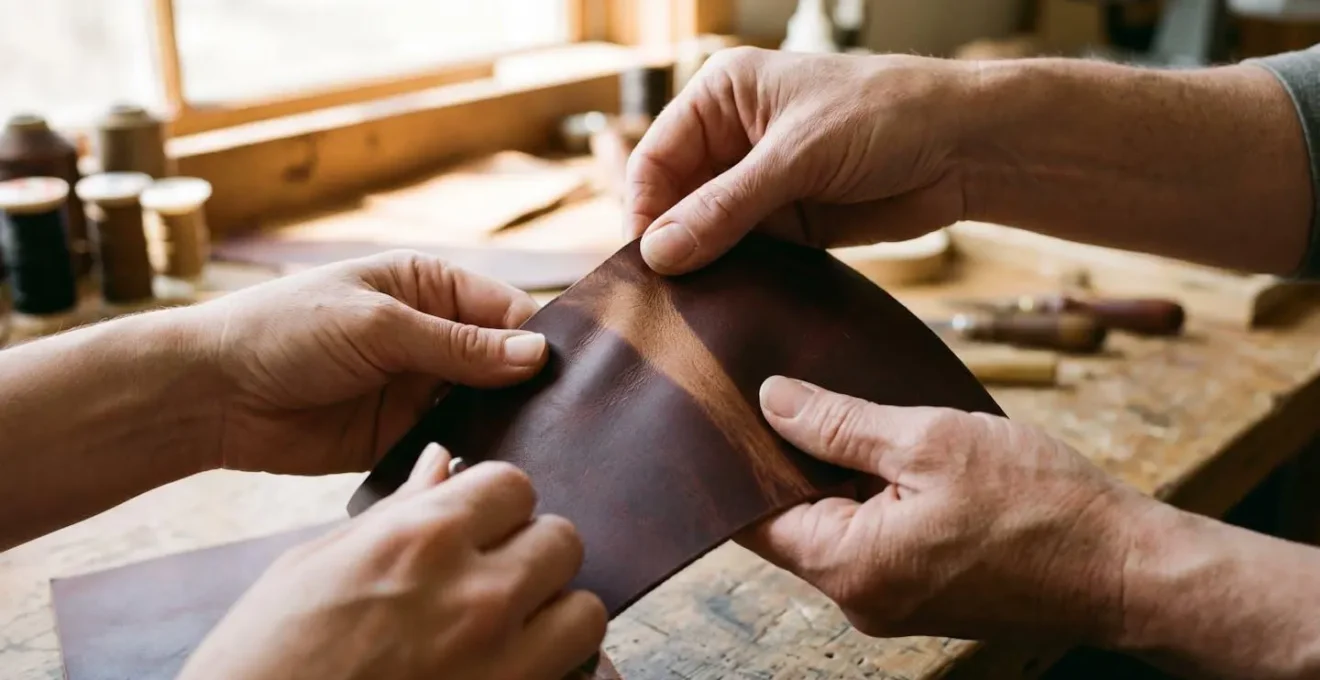
Second, look for leathers with minimal, oil-based finishes. Pull-up leather is a prime example. This is an aniline-dyed leather that is saturated with oils and waxes. When you pinch or stretch it, the oils move around, causing the colour to lighten in that area—this is the « pull-up effect. » This is a fantastic test to perform in a showroom. It proves the leather is rich with the very oils that will allow it to self-heal minor scuffs and develop a rich, complex patina over time, rather than drying out and cracking.
Natural veg tan leather actually looks better with age. It patinas over time, developing a greater depth of color and eye-catching sheen.
– Sailrite Leather Experts, Understanding Chrome Tan vs. Veg Tan Leather
Why Do Hand-Sewn Seams Look Uneven but Last Twice as Long?
In a world of machine-made perfection, a hand-sewn seam can look almost rustic, with stitches that aren’t perfectly uniform. It’s easy to mistake this irregularity for a lack of quality, but the opposite is true. The slight unevenness of a hand-sewn seam is the visual signature of a far superior construction method: the saddle stitch. This technique is the gold standard for durability and is a clear indicator of high-end craftsmanship.
A machine uses a lockstitch, where two separate threads interlock within the leather. If one of these threads breaks, the other has no support, and the entire seam can quickly unravel. It’s a system with a single point of failure. A hand-sewn saddle stitch, however, is fundamentally different and far more robust. It uses a single thread with a needle at each end, passing through the same hole from opposite directions. This creates a continuous, interlocking loop of thread along the entire seam.
This structural difference is the key to its longevity. The principle at play is mechanical redundancy. Each stitch is, in a sense, locked by the one before and after it. This inherent backup system is why hand-sewn leather goods can withstand decades of stress, far outlasting their machine-sewn counterparts.
Case Study: The Superiority of the Saddle Stitch
The two-needle saddle stitch creates a continuous loop through the leather, unlike a machine lockstitch. When one thread in a saddle stitch breaks, the other thread continues to hold the seam together, preventing catastrophic failure. This mechanical redundancy is the primary reason hand-sewn saddle stitches can last decades longer than machine stitching. The slight irregularity in the stitches, often caused by hand-punched holes and variable tension, is the very proof of this stronger, more resilient manual process that, as many leather artisans attest, is a hallmark of true quality.
So when you’re examining a piece of furniture, run your fingers along the seams. Look for that subtle, handsome irregularity. It’s not a flaw; it’s a promise of durability, a testament to an item built to be used and to last.
Key takeaways
- The best leather is imperfect: Full-grain hides proudly display natural markings, which are signs of strength, not flaws.
- Your environment is a factor: In the UK, central heating is leather’s biggest enemy, making a seasonal conditioning schedule essential.
- Look beyond looks: A seam that looks slightly uneven might be a hand-sewn saddle stitch, which is exponentially more durable than a perfect machine stitch.
How to Choose a Statement Chair That Still Feels Comfortable After 2 Hours?
A statement chair is often bought with the eyes, but it is lived in with the body. A breathtaking design can become a source of regret if it’s uncomfortable to sit in for more than a few minutes. True, lasting comfort is not a matter of luck; it’s a function of ergonomics and quality materials. To avoid a beautiful but useless piece of furniture, you must perform a few physical tests in the showroom to assess its long-term comfort potential.
First, ignore the initial « ahh » moment. Any chair can feel good for 60 seconds. The real test is how it supports your body over time. The key ergonomic factors are seat depth, backrest angle (rake), and foam density. A seat that is too deep will press against the back of your knees, cutting off circulation, while one that is too shallow will offer no thigh support. The backrest rake determines your posture; a more upright chair is for conversation, while a more reclined rake is for lounging. Neither is better, but you must choose the one that matches the chair’s intended use.
The most overlooked component is the foam core. Low-density foam feels wonderfully soft at first but will compress quickly, leaving you feeling the hard frame underneath—a phenomenon known as « bottoming out. » High-density foam, often wrapped in a softer layer of feather or down, provides both initial softness and lasting support. You must specifically ask about the core construction, as it’s the invisible heart of the chair’s comfort.
Your Checklist: Ergonomic Tests for Long-Term Comfort
- The Seat Depth Test: Sit with your back firmly against the backrest. You should be able to fit two or three fingers between the back of your knees and the edge of the seat.
- Backrest Rake Assessment: Consider the chair’s purpose. Does the recline angle support an upright, engaged posture for reading, or a relaxed, reclined position for watching TV? Ensure it matches your needs.
- Foam Density Inquiry: Ask the salesperson directly: « What is the density of the foam core, and is it wrapped? » A quality chair will often feature a high-resiliency foam core with a feather/down wrap.
- The 10-Minute Trial: Don’t just sit and stand. If possible, sit in the chair for at least 5-10 minutes. Read a few pages on your phone. This mimics real-world use and reveals comfort issues that a quick test won’t.
- Pressure Point Check: As you sit, pay close attention to your body. Do you feel specific pressure points under your thighs or on your lower back? A well-designed chair should distribute your weight evenly.
Now, armed with this forensic knowledge of leather types, seam construction, and ergonomic principles, you are no longer just a consumer. Step onto that showroom floor not as a potential victim of marketing, but as a confident, informed expert, ready to make an investment that will bring you comfort and pride for decades to come.