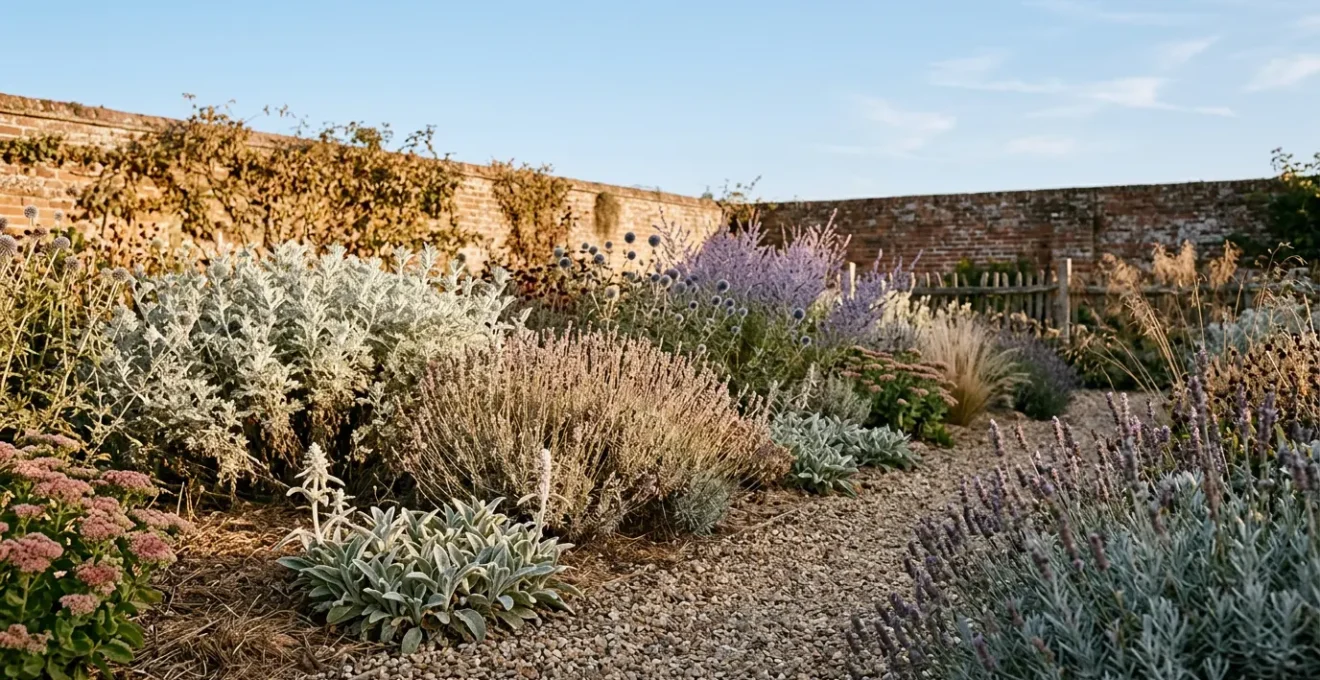
The key to a garden that thrives through a UK hosepipe ban is not just choosing ‘drought-tolerant’ plants, but fundamentally shifting your gardening mindset from constant nurturing to building strategic resilience.
- Conventional mulching and watering can actively harm plants adapted to dry conditions by causing root and crown rot.
- Success lies in mimicking a plant’s natural arid habitat through specific soil preparation, intelligent mulching, and deep, infrequent watering.
Recommendation: Audit one of your garden borders. Replace organic mulch around Mediterranean plants with gravel and adopt a ‘deep soak’ watering method once a week, not a daily sprinkle, to build a truly resilient, low-water garden.
There’s a familiar sense of dread for the British gardener when summer truly arrives. The lawn starts to crisp, the vibrant colours of the borders begin to fade, and then comes the email from the local water authority: a hosepipe ban is imminent. The default response is often a frantic dash to the garden centre, grabbing anything with a « drought-tolerant » label, and a desperate, guilt-ridden regime of watering can trips. We are taught that good gardening is about nurturing, feeding, and constant care, so we apply thick layers of compost and bark mulch, believing we are locking in precious moisture.
But what if these well-intentioned habits are precisely what’s setting our gardens up for failure? What if the secret to a vibrant border that laughs at a six-week drought isn’t about more care, but a different, smarter kind of care? The solution lies in a radical mindset shift, moving away from the soft, coddled environment of a traditional British garden and towards a philosophy of ‘tough love’. It’s about building strategic stress to encourage deep, self-sufficient roots and creating a micro-ecosystem where plants are enabled to fend for themselves, just as they do in their native, arid environments.
This isn’t about creating a barren desert of rocks and cacti. It’s a forward-thinking approach, adapting Mediterranean xeriscape design to the UK climate to create lush, colourful, and textured borders that are not only beautiful but resilient. This guide will deconstruct this plant-positive method, showing you how to understand plant adaptations, make critical choices about mulch and soil, and master watering techniques that build resilience from the ground up, ensuring your garden remains a source of joy, not anxiety, all summer long.
To help you navigate this new approach to gardening, this article breaks down the essential principles for creating a beautiful and resilient garden. The following sections will guide you through understanding plant needs, mastering soil and watering techniques, and designing for both beauty and low-maintenance longevity.
Contents: A Blueprint for a Hosepipe-Proof Garden
- Why Does Your Lavender Thrive While Your Hydrangea Wilts in the Same Dry Spell?
- How to Grow Sempervivum in a Northumberland Garden Without Winter Losses?
- Bark Mulch or Gravel: Which Keeps Soil Moist Longer in a South-Facing Border?
- The First-Year Watering Mistake That Kills 40% of Newly Planted Perennials
- When to Plant Drought-Tolerant Perennials: Autumn or Spring in the UK?
- Why Does Your Lawn Need Feeding Every Spring Despite Composting All Year?
- Why Does Your Friend’s Tiny Courtyard Feel More Calming Than Your Large Lawn?
- How to Design a Garden That Reduces Stress Measurably in Just 15 Minutes a Day?
Why Does Your Lavender Thrive While Your Hydrangea Wilts in the Same Dry Spell?
The answer to this question is the foundation of water-wise garden design. It’s not just about a plant’s thirst; it’s about its entire evolutionary strategy. A hydrangea is a « drinker, » engineered with large, thin, green leaves that lose water rapidly through transpiration. It expects a steady supply from the soil. A lavender, conversely, is a « survivor. » Its entire form is built to conserve every last drop of moisture. Understanding these built-in adaptations is the first step towards creating a resilient border.
The most obvious clues are in the foliage. Many drought-survivors have evolved specific physical traits to minimise water loss in hot, sunny, and windy conditions. These features are not just aesthetic; they are high-performance survival mechanisms. The RHS highlights a key characteristic to look for is silver or grey-green foliage with fine hairs, which serve to trap a humid layer of air right at the leaf’s surface, reducing evaporation and reflecting harsh sunlight.

As you can see in the texture of these lavender leaves, the silvery appearance isn’t just a colour. It’s a dense layer of tiny, reflective hairs. Other plants, like Stachys byzantina (Lamb’s Ear), have thicker, felt-like hairs, while succulents like Sempervivum store water in fleshy leaves. Choosing plants with this visible survival architecture—small, silvery, hairy, or succulent leaves—over those with large, lush, green leaves is the most effective way to build a garden that won’t wilt at the first sign of a dry spell.
How to Grow Sempervivum in a Northumberland Garden Without Winter Losses?
For many drought-tolerant plants in the UK, the greatest threat isn’t a summer heatwave but a cold, wet winter. A Sempervivum, or houseleek, can survive freezing temperatures and bone-dry soil, but its one true vulnerability is sitting in waterlogged ground. In a place like Northumberland, where winter can be long and damp, the key to survival is not insulation but perfect drainage. The plant’s crown—the point where the leaves meet the roots—is highly susceptible to rot if it remains wet for extended periods.
To prevent this, you must create an environment that actively sheds water away from the plant. This means thinking less about soil enrichment and more about soil respiration—allowing air to circulate around the roots and crown. The most effective way to achieve this is to construct a « mini-scree, » a small, gritty, free-draining habitat that mimics the alpine slopes where these plants naturally thrive. You are not just planting in soil; you are engineering a specific, localised ecosystem. This ensures the plant’s roots get the moisture they need without the crown ever becoming waterlogged.
Action Plan: Building a Winter-Proof Scree for Alpines
- Elevate the Position: Plant on elevated mounds, slopes, or the top of a rockery where winter rainfall naturally drains away from the roots and crown.
- Amend the Soil: If you have heavy clay, incorporate a generous amount of horticultural grit or sharp sand into the top 15cm of soil to improve its structure and porosity.
- Apply a Mineral Mulch: Use a 5cm (2in) layer of gravel, grit, or slate chippings as a decorative mulch. This is critical as it keeps the plant crown dry and prevents soil from splashing onto the leaves.
- Provide Shelter: Create microclimates by planting on the leeward side of rocks or larger, hardier perennials. This shields the plant crowns from the worst of the winter downpours.
- Choose Small Specimens: Start with smaller plants. They establish more quickly and gradually acclimate to your garden’s specific conditions as they grow, developing a more resilient root system.
By focusing on preventing crown rot through superior drainage, you can successfully grow a wide range of beautiful alpine and Mediterranean plants, even in the wetter parts of the UK. It’s a classic example of the ‘tough love’ approach: giving the plant the sharp, gritty conditions it craves, not the rich, damp soil we might assume it wants.
Bark Mulch or Gravel: Which Keeps Soil Moist Longer in a South-Facing Border?
This question reveals one of the most common and fatal mistakes in drought-tolerant gardening. While both materials act as a mulch to suppress weeds and regulate soil temperature, their effect on moisture is profoundly different, and choosing the wrong one can be a death sentence for your plants. The conventional wisdom is that organic mulch like bark is best because it retains moisture. Indeed, research cited by the University of Maryland Extension found that organic mulch can lead to a 25-70% reduction in soil moisture evaporation.
For moisture-loving plants like Hostas or Ferns, this is ideal. However, for Mediterranean plants like Lavender, Rosemary, or Thyme, this constant dampness around the base is disastrous. These plants have evolved to thrive in soils that dry out quickly between rainfalls. A thick layer of bark mulch traps moisture against the plant’s crown, creating the perfect conditions for the fungal diseases that cause crown rot. In a wet UK climate, this can kill a lavender plant within a single season.
Gravel or horticultural grit, on the other hand, provides a dry, airy collar around the plant’s base. It allows water to pass through quickly to the roots below but ensures the crown itself remains dry and can « breathe. » It acts as a protective barrier against the very conditions that organic mulch creates.
Case Study: The Hybrid Mulching Strategy
A comparative study highlighted that applying bark mulch around lavender, rosemary, or other Mediterranean herbs in wet UK climates almost guarantees early death. The organic mulch keeps the plant crown perpetually damp, allowing rot to set in within a season or two. The study identified gravel as the only viable solution for the immediate vicinity of these rot-prone plants, as it provides the sharp drainage they need. However, it also recommended using bark mulch in the wider border area, away from the crowns, to benefit more moisture-loving plants like Salvias and to improve overall soil health. This hybrid approach—gravel around the sensitive crowns, bark for the rest—prevents rot while maintaining soil fertility across the border.
The choice is therefore strategic, not aesthetic. For a resilient, mixed border, use gravel mulch for your Mediterranean and alpine plants, and save the bark mulch for perennials and shrubs that appreciate more consistent moisture.
The First-Year Watering Mistake That Kills 40% of Newly Planted Perennials
After carefully selecting and planting a new perennial, the instinct is to nurture it with a little water every day. This gentle, frequent watering is the single biggest mistake a gardener can make, and it’s the primary reason so many new plants fail to establish. It encourages the development of a shallow, lazy mat of roots near the surface that becomes completely dependent on constant moisture. The moment a dry spell hits or you forget to water for a few days, the plant has no deep roots to search for moisture and quickly wilts and dies.
The solution is counter-intuitive: water less frequently, but more deeply. This ‘tough love’ approach applies a form of strategic stress, forcing the plant to develop a deep, extensive, and resilient root system in search of water. As RHS Horticultural Advisors state in Garden Gate Magazine, « A quick drink every day just encourages spindly roots. Instead, deep and less frequent watering is best to promote long roots. » This deep watering encourages the growth of a robust root architecture that can sustain the plant through inevitable dry periods.
The correct technique is the ‘deep soak’. Instead of a quick spray with a hose, you should apply water slowly and directly to the base of the plant for several minutes, allowing it to penetrate far down into the soil profile. A highly effective method is to create a small ‘moat’ or basin of soil around the plant’s base to hold the water and let it soak in gradually.
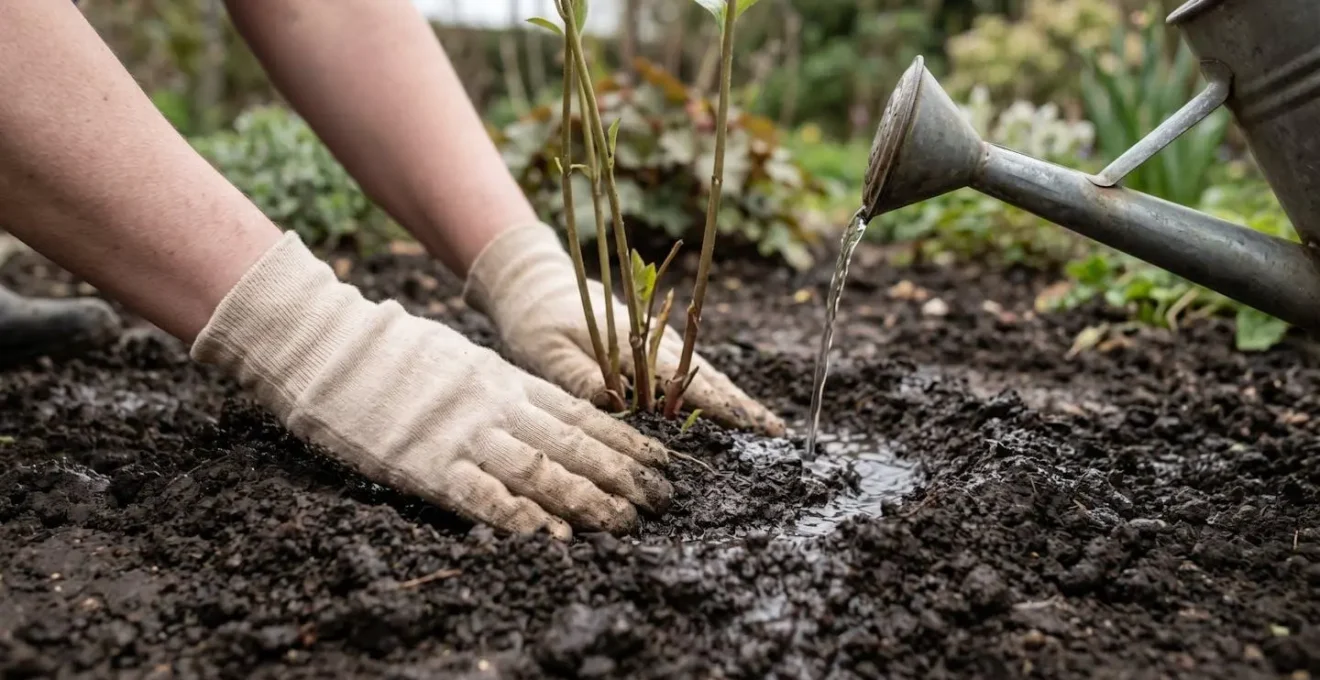
For a newly planted perennial, a deep soak once or twice a week (depending on weather) is far more effective than a light sprinkle every day. This trains the plant from day one to be self-sufficient, building the hidden foundation it needs to thrive not just for the first year, but for many years to come, with minimal intervention from you.
When to Plant Drought-Tolerant Perennials: Autumn or Spring in the UK?
The timing of planting is another strategic decision that can dramatically affect the long-term success of your drought-tolerant border. In the UK, gardeners face a distinct trade-off between autumn and spring planting. There is no single correct answer; the optimal time depends on the plant’s hardiness and your local soil conditions, particularly in winter. Autumn planting (September-October) is often lauded because the soil is still warm from the summer, and the reliable rainfall helps plants establish a deep taproot before they go dormant. This gives them a significant head start for the following summer.
However, for less hardy plants or those particularly susceptible to crown rot, an autumn planting can be fatal. Sitting in cold, wet soil all winter is more of a threat than any summer drought. Spring planting (April-May) avoids this risk, giving the plant a full growing season to get established before it has to face its first harsh winter. The downside is that its root system will be less developed when the first dry spell of summer arrives, requiring more diligent deep-watering during its first year.
Therefore, a targeted approach based on plant type and soil is essential.
- Truly hardy perennials (e.g., Geranium sanguineum, Stipa gigantea) thrive with autumn planting, taking full advantage of the damp soil to develop their root architecture.
- Silver-leaved, less hardy, sun-loving perennials (e.g., Lavender, Santolina) are best planted in spring. This allows their roots to establish well before facing the dual threat of cold and wet.
- Borderline-hardy plants (e.g., certain Agapanthus, Verbena bonariensis) should always be planted in spring to give them the longest possible growing season before winter.
- On heavy clay soils prone to waterlogging, it is almost always safer to default to spring planting for all but the most bomb-proof plants.
- On well-drained, sandy soils, especially in the southern UK, autumn planting is ideal for most drought-tolerant perennials.
It is also important to manage expectations for establishment. While perennials may establish in a year, the RHS recommends that even large, drought-tolerant tree specimens may require watering for up to three years to become fully self-sufficient. Starting small with younger plants helps them adapt more effectively to your garden’s unique environment.
Why Does Your Lawn Need Feeding Every Spring Despite Composting All Year?
The contrast between a demanding lawn and a self-sufficient perennial border perfectly illustrates two different ecological systems. A perennial border, when designed well, functions like a natural woodland floor. Leaves fall, decompose in situ, and return their nutrients to the soil, creating a closed-loop, self-sustaining system. A lawn is the exact opposite. It’s an open-loop system based on constant removal. Every time you mow the lawn and remove the clippings, you are exporting nutrients from the soil. This nutrient deficit must be replaced artificially with fertilisers every year.
More critically in the context of a hosepipe ban, the lawn is a vast, inefficient monoculture of shallow-rooted plants. It has an insatiable thirst and offers little in return for its high water consumption. A lush green lawn is one of the most water-intensive features in any garden. To put it in perspective, research shows the average hosepipe uses around 170 litres of water every ten minutes. Keeping a medium-sized lawn green during a dry spell can consume thousands of litres of precious water—water that could be used far more effectively on a single ‘deep soak’ for an entire border of resilient perennials.
This is why a key principle of forward-thinking, resilient garden design in the UK is to question the dominance of the lawn. Reducing the size of the lawn and replacing it with deep, mixed borders of drought-tolerant plants is the single most impactful change you can make to reduce your garden’s water consumption. It not only saves water and reduces the stress of a potential hosepipe ban but also creates a richer, more diverse, and lower-maintenance habitat.
Why Does Your Friend’s Tiny Courtyard Feel More Calming Than Your Large Lawn?
This common experience highlights a fundamental principle of landscape psychology: a feeling of calm and security in a garden often comes from enclosure and complexity, not from open space. A large, flat lawn can feel exposed, monotonous, and featureless. It offers « prospect » (a clear view) but no « refuge » (a sense of being sheltered or protected). Our brains are wired to feel more at ease in environments that offer a balance of both.
A small courtyard, by its very nature, excels at providing this sense of refuge. The surrounding walls or fences create a feeling of a private, outdoor room. This enclosure focuses your attention inward, away from the outside world, and magnifies the impact of the sensory details within it. The sound of a small water feature, the scent of a single climbing rose, the varied textures of stone, wood, and foliage—all are concentrated in a human-scale space. A large lawn, by contrast, dilutes these sensory inputs across a vast, undifferentiated expanse.
Furthermore, the courtyard invites exploration, even on a small scale. A winding path, a collection of varied pots, a strategically placed bench—these elements create a short but engaging journey. A lawn, on the other hand, is a single visual statement that is understood in a single glance. It offers no mystery and no invitation to engage more deeply. The perceived ‘stress’ of a large lawn also comes from its high-maintenance demands—the constant need for mowing, feeding, and watering to maintain its perfect, unnatural state. A well-designed courtyard filled with resilient plants can be a far more relaxing and lower-maintenance space, proving that in garden design, the quality and thoughtful arrangement of space is far more important than the quantity.
Key Takeaways
- True drought resistance comes from a systemic approach—soil, mulching, and watering—not just plant selection.
- The wrong mulch (organic bark) on the wrong plant (Mediterranean) is a common cause of failure due to crown rot. Gravel is a survival tool.
- Deep, infrequent watering builds strong, self-sufficient root systems. Frequent, shallow watering creates weak, dependent plants.
How to Design a Garden That Reduces Stress Measurably in Just 15 Minutes a Day?
A truly stress-reducing garden is, by definition, a resilient one. The greatest source of stress for many gardeners is the constant worry: « Will my plants survive? Do I need to water them? Why does that look like it’s dying? » A garden that is designed to thrive with minimal intervention eliminates this background anxiety, allowing you to simply enjoy the space. The principles of water-wise design are therefore the principles of stress-free garden design. It is a shift from a garden that needs life support to one that is a self-sustaining ecosystem.
This means embracing plants with strong year-round structure—evergreen shrubs, ornamental grasses that hold their form through winter, and perennials with persistent seed heads. This ensures the garden has a constant, stable, and calming visual backbone that doesn’t depend on the fleeting perfection of peak-season flowers. The goal is to create a space that looks intentional and beautiful even in the depths of winter or the height of a drought, reducing any sense of loss or failure in the « off-seasons. »
Proof of Concept: The RHS Dry Garden at Hyde Hall
The RHS Dry Garden at RHS Garden Hyde Hall serves as a living masterclass in resilient, stress-free garden design. This inspirational planting scheme has, remarkably, not been watered since its establishment in 2001, proving that selecting the right plants eliminates the primary garden stressor: the chore of life-support watering. The garden showcases award-winning plants including Cistus, Salvia, Yucca, and Lupinus arboreus. These plants provide year-round structural integrity with evergreen backbones and persistent winter seed heads, ensuring a constant, stable, and calming visual that doesn’t rely on ephemeral flowers, thus reducing the gardener’s sense of anxiety during off-seasons.
Spending just 15 minutes a day in a space like this—not weeding, not desperately watering, but simply observing the subtle changes, the visiting insects, and the play of light on textured foliage—has a measurably positive impact on well-being. By designing for resilience, you are not just creating a drought-proof garden; you are creating a reliable sanctuary for yourself.
Start your journey to a stress-free, beautiful garden today by auditing one border. Assess your plant choices, check your mulch, and commit to the ‘deep soak’ watering method. Embracing these resilient principles is the first step toward creating a garden that nurtures you, instead of the other way around.