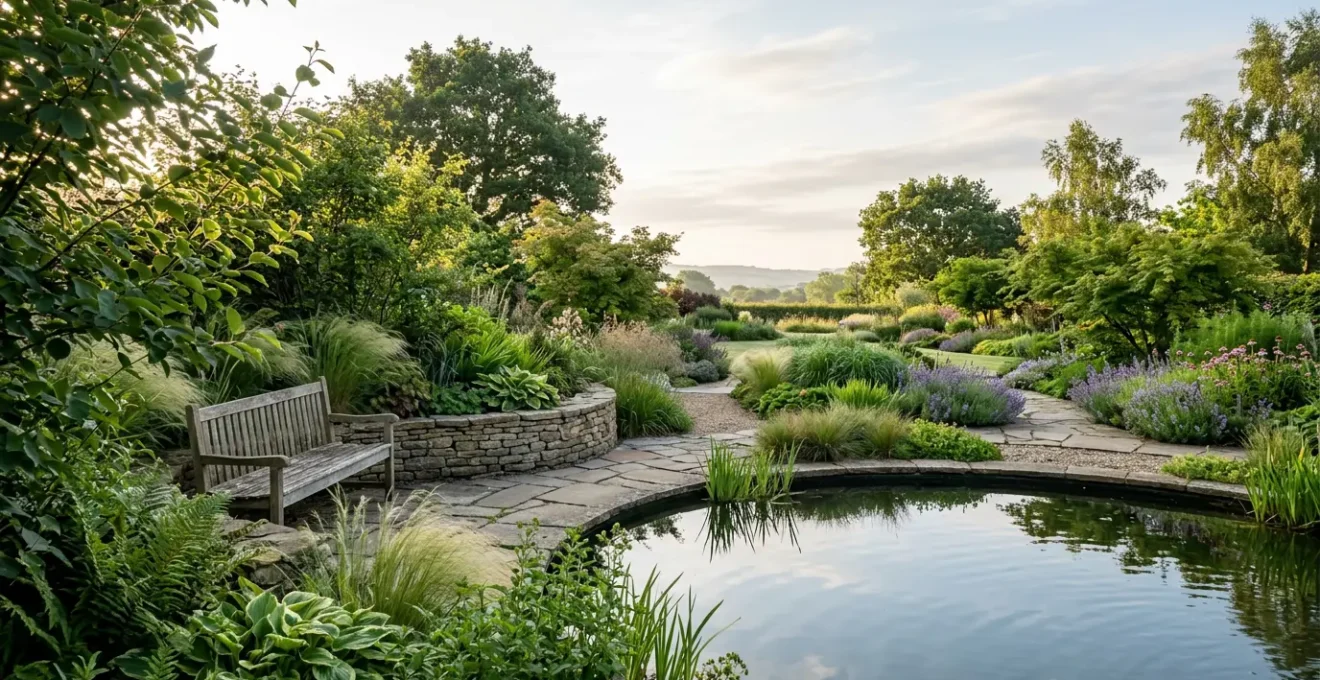
The key to a stress-reducing garden isn’t adding more calming elements, but engineering a sensory environment that actively regulates your nervous system.
- Psychological safety (prospect-refuge) and engineered sound are more effective at reducing stress than simply having an open lawn or a generic water feature.
- Specific plant scents like jasmine have a measurable, drug-like calming effect on the brain, while diverse planting reduces the stress of maintenance.
Recommendation: Shift your focus from how your garden looks to how it makes you feel, using evidence-based principles to design for specific neurological and physiological outcomes.
As a UK professional, your day is a gauntlet of deadlines, notifications, and cognitive demands. The conventional wisdom is that your garden should be an escape—a green oasis of calm. You’ve followed the advice: you have the lawn, the neat flowerbeds, perhaps even a piece of garden art. Yet, the space doesn’t deliver that promised sense of deep restoration. You find yourself feeling more at ease in a friend’s tiny, enclosed city courtyard than in your own spacious garden, and you can’t figure out why.
The standard approach to garden design often focuses on visual aesthetics, treating the space like an outdoor room to be decorated. We’re told to add water features, scented plants, and comfortable seating. But this advice misses a crucial point: a truly therapeutic garden isn’t a passive collection of objects. It’s an active, precisely-calibrated system designed to interact directly with your neurobiology. The reason your expensive garden might be failing is that it’s designed for the eyes, not the nervous system.
This guide will move beyond the platitudes. We will not be discussing colour theory or lawn maintenance. Instead, we will delve into the evidence-based principles of therapeutic landscape design. We’ll explore how to engineer sound to mask urban noise, why the scent of jasmine can be as effective as a sedative, and how the right kind of light exposure at the right time of day can recalibrate your entire stress response system. The goal is to transform your garden from a source of chores into a powerful, daily tool for mental wellbeing.
This article provides a structured path to understanding and implementing these principles. We will deconstruct the science behind restorative environments, from the psychology of space to the chronobiology of light, providing you with a practical framework for creating a garden that measurably reduces stress in just 15 minutes a day.
Summary: How to Design a Garden That Reduces Stress Measurably in Just 15 Minutes a Day
- Why Does Your Friend’s Tiny Courtyard Feel More Calming Than Your Large Lawn?
- How to Choose a Water Feature That Masks Traffic Noise in a City Garden?
- Jasmine or Night-Scented Stock: Which Fragrance Improves Sleep Quality?
- The High-Maintenance Planting Mistake That Turns Gardens Into Stressful Chores
- When Is the Best Time of Day to Spend 15 Minutes in Your Garden for Stress Relief?
- Why Does Your Bright Bathroom Light Sabotage Your Sleep Routine?
- Why Does Your All-White Room Feel Clinical Despite Expensive Furniture?
- How to Design a Home Lighting Scheme That Supports Your Body Clock Year-Round?
Why Does Your Friend’s Tiny Courtyard Feel More Calming Than Your Large Lawn?
The feeling of calm in your friend’s small courtyard isn’t an accident; it’s a deeply ingrained evolutionary response. The answer lies in Prospect-Refuge Theory, a cornerstone of environmental psychology. This theory posits that humans are innately drawn to environments that offer both « prospect » (an unimpeded view of the surroundings) and « refuge » (a place of concealment and protection). A large, open lawn offers maximum prospect but zero refuge. This creates a subtle but persistent sense of vulnerability and exposure, which is the opposite of calming.
In contrast, a small, enclosed courtyard, often with a high wall or fence behind a seating area, perfectly satisfies this need. You can sit with your back protected (refuge) while still observing the garden (prospect). This configuration signals safety to the primitive parts of our brain, allowing the nervous system to down-regulate and enter a state of rest. It’s not about the size of the space, but the psychological sense of security it provides. The open lawn might be visually impressive, but the enclosed nook is experientially restorative.
The same spatio-visual configuration (the same volume of outlook and enclosure) in an interior overlooking a city skyline, will trigger a different psychological reaction.
– Dosen & Ostwald, Evidence for prospect-refuge theory
Therefore, to make your own garden more calming, resist the urge to keep everything open. Create a dedicated seating area that is a defined « refuge » – place a bench against a wall, under a pergola, or nestled within a cluster of tall, robust planting. This simple act of creating enclosure transforms a patch of your garden from a space you look at into a space you can inhabit with a profound sense of peace.
How to Choose a Water Feature That Masks Traffic Noise in a City Garden?
In an urban environment, a garden’s primary acoustic challenge is overcoming the constant, stressful drone of traffic. The common advice to « add a water feature » is often ineffective because it ignores the science of psychoacoustics. It’s not the presence of water but the specific frequency and complexity of its sound that determines its ability to mask unwanted noise. A gentle trickle from a small statuette will be utterly consumed by the low-frequency rumble of a passing lorry.
To be effective, the water sound must compete with the intrusive noise. Research into urban soundscape enhancement provides a clear, evidence-based directive. A study published in Noise Control Engineering Journal found that for a water feature to effectively mask traffic sounds, its own sound level needs to be carefully calibrated. Specifically, the water sound level should be similar to or not less than 3 dB below the urban noise level it is intended to obscure. This means a louder, more complex sound is required.

This doesn’t mean you need a deafening waterfall. The key is tonal complexity and a broad frequency spectrum. Instead of a single stream, choose a feature where water falls onto various surfaces—splashing over different sizes of stone, cascading down a textured wall, or bubbling up through a large urn to create a combination of gurgles, splashes, and hisses. These varied, mid-to-high frequency sounds are much more effective at capturing our attention and masking the low-frequency drone of traffic, creating a « sound shield » that allows the mind to relax.
Jasmine or Night-Scented Stock: Which Fragrance Improves Sleep Quality?
While many fragrant flowers can make a garden pleasant, certain scents have a profound and measurable impact on our neurochemistry. When it comes to improving sleep quality, the choice is clear and backed by science: jasmine. The calming effect of jasmine is not just a pleasantry; it’s a potent GABAergic agent, meaning it acts on the brain in a way remarkably similar to common pharmaceutical sedatives.
The neurotransmitter GABA (gamma-aminobutyric acid) is the body’s primary inhibitory messenger, responsible for calming nerve activity, reducing anxiety, and inducing sleep. Breakthrough research from Ruhr University Bochum in Germany has shown that the fragrant components of jasmine can dramatically amplify GABA’s effects. In laboratory studies, it was found that jasmine fragrances increased the GABA effect by more than five times, acting as powerfully as barbiturates or propofol without the associated side effects. Night-scented stock (Matthiola longipetala) has a delightful evening perfume, but it doesn’t possess this specific, potent neurological mechanism.
Case Study: The Clinical Impact of Jasmine on Sleep
To test this neurological finding in a real-world context, a clinical trial was conducted. A randomized, double-blinded crossover trial involving 30 individuals identified as sensitive sleepers showed that exposure to a synthetic jasmine scent during the night had a significant clinical benefit. Participants experienced a measurable reduction in « wake after sleep onset » and saw overall improvements in both their perceived sleep quality and total sleep time when compared to nights without the scent.
For the UK professional seeking better sleep, this has a direct application. Planting a climbing jasmine (like Jasminum officinale) near a bedroom window or a patio where you sit in the evening is not just an aesthetic choice. It is a targeted, non-pharmacological intervention to prime your brain for rest. Inhaling its scent is a direct pathway to enhancing your body’s natural calming mechanisms.
The High-Maintenance Planting Mistake That Turns Gardens Into Stressful Chores
One of the biggest sources of garden-related stress is the feeling of being overwhelmed by chores: endless weeding, pest control, and watering. This is often a direct result of a common but flawed planting strategy: monoculture. A monoculture is the practice of planting large blocks of a single type of plant, like a vast lavender border, a bed of only roses, or a hedge of a single species. While visually uniform, these designs are inherently fragile and stress-inducing.
A monoculture is an open invitation for pests and diseases. If a specific bug or fungus that targets your chosen plant arrives, it has an all-you-can-eat buffet with no natural predators to stop it. The entire planting can be decimated quickly, creating a stressful and expensive problem. Furthermore, monocultures exhaust specific soil nutrients and often require more human intervention (fertiliser, pesticides, intensive weeding) to look good. This creates a cycle of dependency where the garden becomes a patient on life support, and you are its constantly worried doctor.
The evidence-based, stress-reducing alternative is polyculture, or companion planting. This involves creating a diverse, interwoven community of different plants that support each other. A resilient polyculture mixes:
- Structural plants: for height and form.
- Flowering perennials: to attract pollinators and beneficial predatory insects.
- Aromatic herbs: which can confuse and repel pests.
- Ground covers: to suppress weeds naturally and retain soil moisture.
A garden designed as a small ecosystem is more resilient, self-regulating, and requires far less crisis management. It trades the clinical neatness of a monoculture for the dynamic, living complexity that our brains are wired to find beautiful and, ultimately, less stressful.
When Is the Best Time of Day to Spend 15 Minutes in Your Garden for Stress Relief?
While any time spent in a garden can be beneficial, for maximum, measurable stress relief, timing is everything. From a chronobiological perspective, the most impactful 15 minutes you can spend in your garden is in the early morning, shortly after waking. This is not about sentimentality; it is about strategically using natural light to regulate your body’s master stress hormone, cortisol.
Cortisol naturally peaks within the first 30-60 minutes of waking in what is known as the Cortisol Awakening Response (CAR). This peak is essential for setting your entire 24-hour body clock, promoting alertness, and regulating your metabolism for the day. Exposing your eyes to bright, natural morning light during this window is the most powerful signal you can send to your brain to ensure a robust and healthy cortisol peak. A strong morning peak is clinically associated with lower overall stress levels, better mood, and reduced evening cortisol, which is crucial for good sleep.

Spending those first 15 minutes outdoors, perhaps with a cup of tea, simply observing the light and tending to a few plants, provides this vital light exposure. It’s far more effective than staying indoors under dim artificial light, which can blunt the cortisol response and leave you feeling groggy and dysregulated. This morning ritual isn’t just a « nice way to start the day »; it is a targeted biological intervention. You are using your garden as a light therapy box to anchor your circadian rhythm and build stress resilience from the ground up, before the day’s demands even begin.
Why Does Your Bright Bathroom Light Sabotage Your Sleep Routine?
You’ve spent a relaxing evening in your garden, your mind is calm, and you’re ready for sleep. Then, you step into your brightly lit bathroom to brush your teeth, and without realising it, you’ve just sabotaged the entire process. The problem lies with the specific quality of the light and its powerful, direct effect on your brain’s sleep-regulating system.
Your retina contains specialised, non-visual photoreceptors called melanopsin retinal ganglion cells. These cells are exquisitely sensitive to blue-spectrum light (the kind found in « cool white » LEDs, fluorescent lights, and screens) and their sole job is to tell your brain whether it’s day or night. When they detect blue light, they send a powerful signal to the pineal gland to immediately suppress the production of melatonin, the primary hormone of sleep. This system is so sensitive that neuroscience research on melanopsin retinal ganglion cells demonstrates that even brief exposure can have a dramatic effect, potentially delaying melatonin onset by over an hour.
Melanopsin retinal ganglion cells, the non-visual photoreceptors in the eye that are highly sensitive to blue light, directly control melatonin production and regulate the entire circadian rhythm system.
– Environmental Sleep Research
That bright, efficient bathroom light, typically chosen for its clarity, is broadcasting a strong « daytime » signal to your brain at the worst possible moment. This single act can undo the calming effects of your evening, pushing back your natural sleep onset and potentially disrupting the quality of your rest. It creates a direct conflict between your behaviour (preparing for bed) and your biology (being told it’s midday). To protect your sleep, evening lighting in bathrooms and bedrooms must be warm in colour (under 2700K) and dim, mimicking the natural transition of sunset.
Why Does Your All-White Room Feel Clinical Despite Expensive Furniture?
You’ve invested in designer furniture and curated a minimalist, all-white aesthetic, yet the room feels sterile and strangely unsettling, not calming. This « clinical » feeling isn’t a failure of taste; it’s a predictable neurological response to sensory deprivation. Our brains evolved over millennia in natural environments rich with pattern, texture, and subtle variation. An all-white, perfectly smooth room is the antithesis of this, and it creates a form of low-grade stress.
The solution isn’t to add random splashes of colour. The key is to re-introduce the « biophilic complexity » that our brains are wired to find calming. Biophilic design expert Shane Pliska notes that the issue is the absence of the natural, non-repeating patterns known as fractals, which are abundant in nature—in the veins of a leaf, the grain of wood, the structure of a fern, or the branching of a tree.
The clinical feeling comes from the absence of natural patterns, textures, and variations (fractals) that our brains are evolved to find calming. The solution is not color, but complexity: wood grain, woven textiles, stone, and plants.
– Shane Pliska
Bringing the calming principles of the garden indoors means layering these natural textures and patterns. Introduce a live-edge wooden table, a woollen or jute rug, linen curtains, stone coasters, and, most importantly, living plants with their intricate foliage. Each of these elements provides the gentle, complex sensory input that the all-white room lacks. This isn’t about creating clutter; it’s about creating a rich but coherent sensory landscape that feels innately safe and restorative to the human brain.
Case Study: Biophilic Design in Healing Environments
Shane Pliska’s design team has worked extensively with major hospitals, assisted living facilities, and memory care communities. Their work provides compelling evidence for these principles. In environments where patients are under significant stress, introducing biophilic design elements—such as indoor plantscapes, natural materials, and views of nature—has been shown to produce measurable reductions in stress biomarkers, improve recovery times, and lower anxiety. This demonstrates that our connection to natural patterns is a fundamental component of wellbeing.
Key takeaways
- Your garden’s ability to reduce stress is determined by its ability to provide psychological safety (prospect-refuge) and sensory regulation, not its size or aesthetic style.
- Targeted sensory inputs, like specific water sounds to mask noise and jasmine scent to activate GABA receptors, are powerful, evidence-based tools for wellbeing.
- Aligning your garden and home environment with your body’s natural circadian rhythm—through morning light exposure and evening light avoidance—is fundamental to managing stress.
How to Design a Home Lighting Scheme That Supports Your Body Clock Year-Round?
The principles of light exposure for stress regulation are not confined to the garden. To truly support your wellbeing, especially during the UK’s long, dark winters, you must extend this thinking to a human-centric lighting scheme throughout your home. This means designing your artificial lighting not just for visibility, but to actively support and anchor your circadian rhythm 24/7, 365 days a year.
A human-centric lighting plan synchronises the colour temperature and intensity of your indoor lights with the natural cycle of the sun. It’s about providing the right light at the right time: a strong, blue-rich « wake-up » signal in the morning, and a warm, gentle « power-down » signal in the evening. This dynamic approach helps regulate the production of cortisol and melatonin, which in turn governs everything from your mood and energy levels to your sleep quality and stress resilience.
Implementing this isn’t just about buying « smart bulbs, » although they can help. It’s about a strategic zoning of your home by time and function. A bright kitchen light is perfect for 8 AM but detrimental at 8 PM. A dim, warm bedside lamp is ideal for reading before sleep but useless for waking you up on a dark winter morning. The key is to match the light to the desired biological outcome for each specific time and place. This conscious approach transforms your home from a source of potential circadian disruption into an environment that actively works to keep your internal body clock on track, which is the foundation of a low-stress life.
Action Plan: Human-Centric Lighting Strategy by Zone and Time
- Morning (7-9 AM): Install bright, cool-temperature lighting (5000-6500K) in your kitchen and bathroom. Use these lights for 15-20 minutes upon waking to provide a strong blue-light signal that supports cortisol regulation and enhances alertness.
- Midday (12-3 PM): Maintain moderate intensity task lighting in work areas. Use bulbs with a natural daylight spectrum (4000-5000K) to maintain attentional focus and concentration without being overly stimulating.
- Evening (post-sunset): Transition all lighting in living areas and bedrooms to a warm, dim colour temperature (2200-2700K). Reduce the intensity progressively as you get closer to bedtime to protect natural melatonin production.
- Winter Adaptation (High Latitudes): During winter months when natural sunlight is weak, increase the intensity and duration of your morning light exposure by 30-50%. Consider using a dedicated SAD lamp for a guaranteed dose of bright, cool light to firmly anchor your circadian rhythm.
- Audit & Replace: Systematically check the bulbs in key areas, especially the bathroom and bedroom. Replace any « cool white » or « daylight » bulbs in evening-use lamps with « warm white » or « soft white » alternatives to create dedicated « circadian-safe » zones.
Begin today by auditing your home and garden, not for how they look, but for how they interact with your senses and your biology. By implementing even one of these evidence-based principles, you can start transforming your living space into a powerful, consistent ally in your pursuit of mental wellbeing.